|
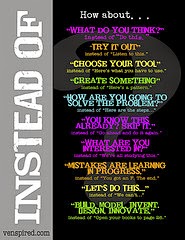
Mike Licht, NoltionsCapital.com |
Sara’s words from Bill’s focus group resonated with my
experience with students in many of today’s schools when she stated, “But if I really want to learn something, I do that
outside of school” (p. 5). My
nephews have expressed this sentiment to me several times as the books they are
given for required reading don’t interest them (therefore they are not
motivated to read). However, outside of
school, my one nephew is an avid reader of hunting, fishing and outdoor life
magazines and websites. He is
well-versed in the local hunting regulations and how to skin and sell pelts.
This did not happen in school. My other nephew is a gamer and deeply
understands the development of online game structure and the connections to
others that playing online affords him.
As a teacher educator
of undergraduate students, I have encountered many pre-service teachers who
understand social media as a personal space, not as a learning space. Like the authors state, “Just because students are “good” with technology does not
necessarily mean they are literate in the digital age” (p. 6). I
continue to show college-age students how to use the settings on Facebook to
provide the type of access they want (or don’t want) and other features that
support Facebook as a learning space. I
try to help them see Twitter as a place for professional connections and
networking, not just personal promotion.
It can be difficult though, to re-envision a tool under new
circumstances. It’s like reading “99 Extraordinary, Creative and Unusual Uses for Ordinary and Everyday Objects” and realizing that tennis balls and Coke can
be very useful items in the house.
“When children are invited to be part of
a community and to spend time in school participating in authentic reading
activities, they grow in amazing ways” (p. 16). As a classroom
teacher, I’ve advocated for the workshop approach in my middle school classroom
(and a modified version in high school) since my first year of teaching. Choice, authentic texts, personal response,
and time has been the foundation of how I’ve tried to teach English Language
Arts. However, I’m still trying to help
people (students, parents, and administration) understand that reading is an
active process that requires more than just Q & A at the end of a
reading. For deep thinking requires
time, re-reading, and discussion – a tough sell in an environment of compliance.
I loved the questions that Franki provided to
re-imagine her workshop and review her use of digital reading. One especially caught my eye as something I
haven’t thought much about, “Do I use keyword tags,
comments, links, and search features while reading aloud?” (p. 19). When I submit articles, I have to include
keywords and tags, when I search for items, I use them – but I haven’t
explicitly talked with students about what they are and how to use them within
the context of the reading. Sure, when
instructing students on Google searching, Boolean logic and keywords are
important, but tags are different features. In addition, I’ve never modelled how I make
choices on whether to follow a link or not when I’m reading. This deserves some thought.
In doing this thinking, I want to consider what types
of digital reading/writing I do:
·
Audio books on my smart phone (mostly
non-fiction)
·
YouTube videos (mostly instructional – how
to style)
·
Personal book blog
·
GoodReads account
·
Personal and professional Twitter accounts
·
Kindle reader – e-Reader – Ipad
·
Downloaded articles in PDF – read and
annotate
·
Google blog lists and Google+
·
Lots of Internet searches – regular and
Scholar
·
On-demand online courses with multimedia
instruction and assignments
·
Museum tours with online access either
through their technologies or my smart phone
·
Google Maps linked to reviews of places
·
Mendeley – a reference manager and PDF
organizer
·
Personal writing apps – 750words.com,
ColorNote, Gratitude Journal
My husband has been a technology director for several
years and his motto has been “Don’t just teach the tools, teach the thinking.” In addition, the tool shouldn’t drive
instruction, instead, the tool should support learning. Too often, we’ve seen teachers spend whole
lessons on helping students learn PowerPoint or any other software, just for the
sake of learning the software. But, the
software ages, changes or is discontinued and without learning how to approach
a new tool, students (and teachers) can be intimidated. Technological tools need to be part of the
learning environment, not an add-on, and only when it makes more sense to use
the tool than the traditional approach.
As Franki wrote, “Digital reading wasn’t an
additional part of the classroom; rather, it became integral to the nature of
our work” (p. 19).
“Figure 2.3. Differences between
traditional and digital reading workshops” on page 21 is a powerful chart
to show how a workshop approach can adapt to integrate digital technologies for
both reading, writing and responding to texts. For me, I need to envision what something
could look like, and this chart gave me the snap-shot I needed to begin to
imagine how the workshop approach would look different when digital reading was
intentional and not an after-thought.
The authors’
statement of the purpose of their digital reading workshop is absolutely beautiful,
“We want our students to be authentic readers and, at the same
time, to be intentional, active, and reflective as they read all forms of
media. Our workshops are therefore set up with beliefs, routines, and
expectations that we hope lead them to live their lives in authentic, intentional,
and connected ways” (p. 22). And
the questions they ask their readers really help put the focus on the student
and his/her active participation within the workshop. It is NOT a passive place – and I know that
some students really struggle with this in the beginning of workshop. They are accustomed to being told what to
read and how to read it. But, having used
the workshop approach for years, I know that it is a powerful way to engage
students in reading and learning.