Thursday, September 12, 2013

Life Lessons in Children's Literature


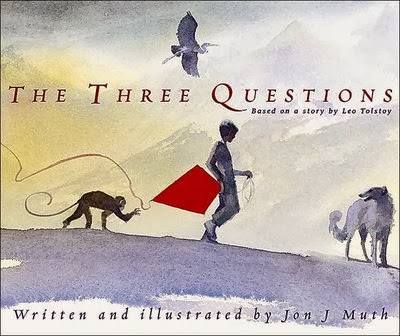
Sometimes a book finds you – rather than you finding a book, and The Three Questions (based on a story by Leo Tolstoy) by Jon J. Muth is a book that found me. In the midst of looking for other topics, my eye was drawn to the muted water color and the fact that there is a children's book based on Tolstoy - not an easy author to understand. I settled down on the floor to enjoy the story.

Nikolai wants to be a good person and sets out to find the answers to three questions: When is the best time to do things? Who is the most important one? What is the right thing to do? 

Like most quest stories, Nikolai consulted several creatures: Sonya, the heron; Gogol, the monkey, and Pushkin, the dog. Each gave answers according to their own perspectives and experiences and their answers did not satisfy Nikolai. Figuring Leo, the wise turtle, might have better answers, Nikolai went to him. Leo was digging and Nikolai offered to help. In the midst of digging, Nikolia heard a cry for help and rescued an injured panda and her cub and cared for them. Through these experiences, Leo observed that Nikolia had the answers to his own questions, “Remember then that there is only one important time, and that time is now. The most important one is always the one you are with. And the most important thing is to do good for the one who is standing at your side.”

From: https://twitter.com/TeachYOUMatter
Just recently a teacher mentioned how discouraged she was with teaching - the Common Core mandates, a district imposed literacy curriculum, and general disrespect of the teaching profession. She said, “There are days that I wonder if it matters. What are we doing?” I reminded her of the tale of the boy walking down the beach and finding an old man throwing the stranded starfish back into the water. There were hundreds of the starfish on the beach and the boy exclaimed, “Why are you doing this? There is no way you can save them all!” The old man turned to the boy, while picking up another, and said, “It matters to this one.”

The teachers I know matter. Each and every day they focus on doing the best they can for each child in their classroom – the ones standing by their side – even in the midst of overwhelming mandates, testing and general discourtesy. It matters – to each child – each day – every day.

Thursday, August 29, 2013

First Day Fears and Hopes

Another school year has begun, and this year, I'm teaching undergrad and graduate courses. But, it is still a new school year, and whether I'm teaching at a new school or just being introduced to a new group of students, I still have the first day jitters. And, I believe, if I ever lose this trait, it is time to hang up my teaching hat. I think the jitters are important to remind myself to constantly be learning about myself, my students, and my content and pedagogy.

Like the actor's nightmare (showing up on stage and not knowing what play is being performed) I think there are teachers' nightmares. On my first day with my new practicum students, I shared my first day jitters and my yearly nightmare of not knowing what classes I'm teaching or having students standing on desks and throwing paper airplanes at me. I hear some teachers have the nightmare of showing up naked to class, though I've never had that one. As my practicum students move into their first classroom experiences, I wanted them to know that anxiety of new experiences is okay, but it shouldn't be paralyzing. I found a great illustrated children's book that really exemplifies this point.

Mr. Ouchy's First Day by Barbara G. Hennessy is about a new fourth-grade teacher on his first day. Like many children, he prepares for the first day by buying new shoes, getting a haircut, has trouble sleeping thinking about the first day, and gets up early to make sure he is on time. At first, the children tease him about his unusual name, but as he begins to engage them in figuring out time, the children begin to discuss how a minute can be interpreted differently under various circumstances. And suddenly, it is recess time! The book then jumps to the end of the day and Mr. Ouchy and the children set goals for learning for the year. The children want to learn how to whistle, swing on a trapeze, train a cat, or make doughnuts. When Mr. Ouchy returns home, he is tired but anticipating the great learning for the year and begins to read up on the children's interests and dreams of his students accomplishing their goals.

After sharing the book, I asked my practicum students to write down a fear, a hope, a question, and something they hope to learn through the year on post it notes. On the white board, I drew a chart with each sectioned labels. As the students thought of something, they could post it, and other students could read various responses. The ideas ranged from very practical (What school will I be at?) to very broad (How do I engage children of all abilities and ages?). Many were concerned about managing a classroom and they wanted to be the best teacher possible. Others wrote about their fear of failure and wanting to be an inspiring teacher.

Although the hopes and fears don't change much from year to year – whether you are a student or a teacher, I think it is important to acknowledge that the first day of school is a day of both excitement and anxiety. Really, this is true for the first day of any new experience. During the roller-coaster of emotions, it is good to know that you are not alone and that these feelings are completely normal. I saw a poster once that said, “The only difference between fear and excitement is your attitude about it. - Unknown.” In the fear and excitement of the first day, I hope to encourage my students to focus on the excitement and let the engagement in lessons alleviate the fear.

Saturday, August 10, 2013

Finding Beauty and Harmony in What is Simple, Imperfect and Natural

I was browsing for books to use with my undergrad class on multicultural education and happened on Wabi Sabi by Mark Reibstein and illustrated by Ed Young. I was immediately drawn into this unusual book that combines collage techniques, with a narrative story and haikus by Basho and Shiki. It is truly an amazing book that I re-read just for the delight of the language, thoughtfulness, and illustrations. In addition, the book reads in an unusual format – it opens up for top to bottom reading, rather than traditional left to right.

The main character is a cat names Wabi Sabi, who wants to know what her names means. However, no one, not even the cat's master, could explain the meaning of wabi sabi. So the cat began to ask all the creatures around her and each give her a different explanation – Snowball, the cat; Rascal, the dog; and a bird, who tells Wabi Sabi to seek out Kosho, the wise monkey. In her travels, Wabi Sabi encounters the bright lights of the city, the cool beauty of the forest, the warmth of friendship, the pleasure of not hurrying, and the joy of returning home. This all is wabi sabi.

Wabi sabi, according to the end pages, is an ancient Chinese philosophy that shaped Japanese culture to emphasize simplicity over extravagance. The format of the book wonderfully illustrates this philosophy.

Here is an interview with the author and illustrator -Wabi Sabi  http://www.youtube.com/watch?v=ca2Ly4Vpb5Y

There's a great educators guide at Hachette Book Group.

In the past, I've taught ancient civilization and used calligraphy painting and haiku techniques to help children understand these cultures. This would have been an amazing book to enhance these units. In addition, it helps me be mindful of the beauty that is inherent in the simplest of things – the dew on the grass, the redness of berries, and the foam on my coffee. All these things are beautiful in themselves.

Wednesday, July 17, 2013

Valuing Perspectives & Opening Networks

Today is the last day of blog postings for #cyberPD discussing chapters 5 and 6 of Who Owns the Learning by Alan November. Laura Komos will be hosting the event today on her blog, Ruminate and Invigorate.  Other participants are posting their links in the comment space and on Twitter with #cyberPD.  Plus, there is a "jog" of all the postings, if you would like to catch up, at Who Owns the Learning? #cyberPD 2013.  Here are my thoughts as I finish the book and think about the future.

“We need to start teaching our students global empathy by developing their ability to understand and appreciate other points of view” (November, 2012, p. 65-66). This is a relevant and essential recommendation from November, and although he focuses on the role of students as global communicators and collaborators, I think developing empathy and respect locally is just as important. Students are living in a world of popular and social media, new programs and cartoons that value and highlight aggressive, egotistical and opinionated personalities that insite conflict and disharmony. Just look at how the cast members of Big Brother, Survivor and other “reality” shows are selected – the goal is to create as much drama and conflict as possible. Where are the models of adults engaging in authentic dialogue that seeks to understand - not just win? Even Congress, in their role as representatives of the people, focus more on party lines and winning than on authentic debate and collaboration.

Narrowing our view points through technology – I knew that Google “personalized” searches, but I guess I didn't realize how extreme this narrowing has gotten. Early in my teaching career, I taught students how to use multiple search engines, because they each searched differently. Now, there is pretty much only Google. Yes, it is easier to find exactly what you want, but as November observed, this develops an over-inflated sense of rightness. I need to be confronted with alternative perspectives to be able to clarify my own understandings, not just confirm. November also commented how the potential of the World Wide Web for building connections and opening up multiple points of views has actually narrowed it more. It is really easy to find your own niche and ignore alternatives.  I've noticed this with my own use of Twitter. Like many others, I tend to follow the people that I have a lot in common with – middle school teachers, literacy people, technology focused educators – but that leaves huge gaps in seeing alternative perspectives. Social media can be a great venue for support – but maybe I need to challenge myself to become “friends” with less like-minded people and expand my own perspective taking.


“Every day, I have to decide if I will write for my teachers or publish to the world” (November, 2012, p. 69). This statement, from a student who wrote prolifically on a fanzine site, but not much at school, really resonated for me. Why would students want to write for an audience of one, when the world could be their audience? Like November stated earlier – how many assignments end up in the trash versus making a long-term impact on a student. As he stated in chapter 6, he remembers experiences from his own schooling, not the tests. Like Vygotsky, I believe that learning is a social process that focuses on individuals making meaning of the world through their interactions with others. It isn't the paper or the test – learning is the process of gathering information, evaluating and synthesizing it to make meaning of it. We have focused too much on highlighting the solo work of students, and not the collaborative process of learning.

Here is a YouTube Video from a 7th grade student, posted in 2009. She describes her personal learning environment. When I first saw it, I was impressed. Now, I'm depressed, as it is 4 years later, and there has been very little support for students (and teachers) to develop these types of learning networks. What are we afraid of?


As November reminds us about what Daniel Pink has noted “the more we grade children on creative work, the less they'll do” (p. 83). Argh! Grading, assessment and evaluation. This is such a long and difficult debate and issue. There are so many political and social aspects of this issue too. But, as November observed before (building on Pink's work) the motivation to learn and take action happens when there is an authentic purpose, autonomy, and mastery. It isn't the reward of grades, money, bonuses or even praise. Real motivation comes from within.


Wednesday, July 10, 2013

Shift of Control

In chapters three and four, November describes two roles for students – that of scribe and researcher. Although new technologies provide different avenues for publication, audience and sources of information, these roles are not new. Remember the classic adage by Benjamin Franklin, “Tell me and I forget. Teach me and I remember. Involve me and I learn.” Pre-digital times, I knew several teachers who sent home student-produced newsletters that described the activities of the week. Granted, in those days, the audience and feedback was not as immediate as a class blog. Which, of course, is part of what makes using technology so powerful.

Like November states, I also believe that having a public forum and audience for writing provides motivation for students to not only write, but to care more about their writing. The recognition from peers, parents and others is more interesting than a single grade from a teacher. On Twitter, I've seen many teachers ask Followers to check out and comment on their students' websites or blogs. I know students love tracking who had comments and where they are from. Many years ago, I had my 10thgrade students use a blog to learn about and respond to Cather in the Rye. This was a group of students who were reluctant to write about their reading in traditional formats like reading response journals or double entry format, but wrote multiple paragraphs when writing on the blog. Besides having a public forum and audience, there was a sense of legacy, as November stated, that encouraged them to revise and take pride in their writing.

For me, the student role of scribe and researcher doesn't seem very radical, but as November states, the challenge “will be redefining the role of learner as contributor, and building a collaborative learning culture” (p. 5). For too long, we have designed learning spaces that require isolated, individual learning and support competition rather than collaboration. This, I believe, is the bigger shift of control – to redefine the classroom expectations, not just introduce technology. And, as November also states, teachers need to do more networking and sharing of their work with their peers. I just completed a study with two third-grade teachers who team-taught in a workshop format. One of the most important catalysts to changing their practice was consistent, collaborative reflection. As teachers, we need to not only open our classrooms, but open our thinking to others.

As November talked about the role of student as researcher, I was thinking about how teachers typically respond to student questions – and not just in K-12 schools but in higher ed. too. I think the most typical response to a student question is to just give the answer. As a culture, we expect teachers and instructors to be experts in their area, and their role is to impart that knowledge to others. The second response I've noticed is the command to “Look it up.” This assumes that students know how to look things up – either in print or online. And, as November found, many students, though digital natives, have very limited repertories of search strategies. This past year I asked my students to research a family artifact. But, I spent almost two weeks in preparation to practice search strategies and evaluation of websites. It was a little frustrating for both students and parents, because they wanted “results” immediately. But, as November showed, there are a lot of bogus websites available, and the top picks of Google aren't necessarily the best. November talked about the website that denied the Holocaust, but here are two other websites that look legitimate but are hoaxes that I have used with students:

The final, less common answer, is the one November illustrated.  Modeling a stance of inquiry, the teacher would say, "How can we find that answer?"

As a graduate student, I returned to university after numerous years as a classroom teacher. I felt overwhelmed by the amount of information and terms I didn't know and I felt stupid to ask, because it looked like everyone else understood. Some professors were supportive of having open laptops in class, other professors felt it was rude to have students typing away during class. In supportive classrooms, I was constantly looking up things I didn't understand and was afraid to show my ignorance. Because of this, I was better able to participate in discussion and understand the material. I try to remember this when I'm teaching.


Monday, July 08, 2013

Education is life itself

As I was reading the first chapters of Who Owns the Learning by Alan November, I was impressed by a couple of quotes that I'd like to ponder here. But, the principles of ownership, purpose, authenticity, autonomy, and self-directed, independent work seemed to stand out in the chapter.

“Education is not preparation for life; Education is life.” - John Dewey. Too often I've heard both teachers and parents explain to their children that what they are doing in school will prepare them for middle school, high school, college or the real world. I know I've used the phrase too, “In high school, your teachers will expect you to know how to write a five-paragraph essay, so we're learning it now in middle school.” But, how authentic is teaching a particular skill, just so it can be mastered in school but not applied in life?

Learning is a social interactive enterprise. In the last year, I had the opportunity to implement a reading/writing workshop in my middle school classroom. We had a set of laptop computers, and a few students brought their own laptops. At the beginning of class, we would meet as a whole group to work on some grammar skills, introduce and practice a new skill, strategy or genre, and review the list of things to do. Usually, students had a choice of activities that including reading, responding, writing, researching or creating a visual response. Then, the students would have workshop time to choose an activity and work on it. Students would grab the computers and spread out across the room. Frequently sitting on the floor with their back against the wall in groups of two or three. As they read or wrote or found an interesting article or fact, they would share with their classmates. I circulated to check in with students, revise with students, or just listen to the conversations. When visitors came into the room, they frequently had trouble finding me, because I was on the floor with the students reading a website or giving feedback on a piece of writing. There was a quiet buzz of activity in the classroom. Students read deeper and wrote more thoughtfully when they had the freedom to talk and share when and how they wanted. Were some students off task at time? Of course, but overall, I think students were more engaged in what they were doing because they had the opportunity to choose their work, their work space, and how they would work.

“We lost the value of children as contributors to the culture of school” (November, 2012, p. 5). A few years ago in a graduate class, I completed a discourse analysis of a set of emails between myself and the parents of one of my students. In George Lakoff's (1980) book Metaphors We Live By, he contends that the metaphors we use every day, often unconsciously, give an indication of how we conceptualize reality. (A summary of Lakoff's chapters 1-4).  In my analysis of the emails I sent to these parents, I conceptualized school as a place of business – with assigned tasks, assigned due dates, and evaluations of performance. I used phrases like, “The report was due on [date] and I haven't even seen a rough draft. Since the work is so late, there will be a deduction in points on the final grade.” However, I was not alone in conceptualizing school as a business or factory. It is the dominate metaphor for American schools ever since Taylor's model of efficiency was introduced into schools which produced a factory-like environment for students. Teacher's Mind Resources has an interesting series about the metaphors of education called Transforming Education Part 3: School as Factory: The Greatest Barrier to Transformation. In the factory model, the contribution of the students are not important -  the efficiency of measuring students against a standard or benchmark is the goal.

November suggests that we need to let go of existing structures of education to provide spaces for students that give autonomy, master, purpose, self-directedness, and independence to students in their learning. But, I have another area that I think we need to examine. What is valued as knowledge in schools? And, what happens when different types of knowledge are valued by different families, teachers, and administration?

Friday, June 14, 2013

#CyberPD "Who Owns the Learning" by Alan November

The #cyberpd event will consist of three parts:

July 3rd: Chapters 1 and 2 - Hosted by Cathy Mere at Reflect and Refine: Building a Learning Community

July 10th: Chapters 3 and 4 - Hosted here at My Primary Passion

July 17th: Chapters 5 and 6 - Hosted by Laura Komos at Our Camp Read-A-Lot

Date to be determined: Final chat about the book on Twitter using the hashtag #cyberpd

You can participate in several ways:

  • You can write a blog post with your thoughts about the section we are reading for the week and add the link to your blog in the comments of the host blog.
  • You can add your thoughts directly in the comments of the host blog.
  • You can share your thoughts on Twitter using the hashtag #cyberpd.
  • You can come up with another way to share you ideas. We would love to see a new, creative way to join the conversation.

Tuesday, April 16, 2013

Laws of Conservation of Pain and Joy

Chris Wejr has a thought-provoking post entitled “Share Who You Are, Let People In”. I remember as a new teacher trying hard to look and sound older than I was, that I hardly ever shared my personal life with my students. I was afraid they would think of me as their friend, rather than their teacher, which I was warned about in my education classes. However, when I taught overseas, it became evident that I needed to reveal myself – my experiences, perspectives and biases – to my students to be able to build common understandings. My students' experiences were significantly different from my own and I knew I couldn't assume commonalities. I now realize how naïve my early teaching self was, thinking that even my American students' experiences were similar to my own.

Students are perceptive and know when you are having an off day. In my experience, when mutual trust and respect is built between the teacher and students, the students will be sympathetic on those few days that you are not on top of your game. I remember when I received word that my grandmother had passed away, I didn't have the words to express it to my students without breaking down, but they sensed my emotions and helped me see that it is okay to be vulnerable in the classroom. It allowed them to be more vulnerable too. I remember that day as one of reverence and deep conversation, in a classroom that was typically filled with activity and noise. I appreciated the intuitiveness of those students.

At the same time, students need to see your real self – the one that also has to do “homework” and chores, just like them. As I've been working on my dissertation, I've shared my struggles with writing and thinking with my students, to help them see that their own homework struggles are not unusual. They were looking forward to the day they could call me “Doctor Who”(they thought that was a better title than my real one). I've also realized that students like stories – stories of my fear of the bat in my apartment, my love of buffaloes, and my scuba diving. When I first started teaching and a student bumped into me at the grocery store, they were shocked, not realizing that I lived a normal life like them. Now, I bump into students at the Roller Derby, Manna Cafe or the grocery store and we can strike up a conversation about their out of school activities without a blink.

But it isn't all one-sided. By sharing my stories with them, they also tell me about their successes and achievements outside of school. This mutual sharing continues to build trust and respect. And, when they are having a bad or off day, they are more willing to share why and I give them the space and time needed to deal with it.

Just as we should remember the Golden Rule of “Do unto others as you would have done unto you, we should also remember Callahan's Law "Shared pain is lessened; shared joy, increased — thus do we refute entropy." (Spider Robinson, Callahan and Company)

Monday, March 11, 2013

Less than an Elevator

Starting the first week of graduate school, most students are asked, "What is your research?"  Heading off to a conference to present a paper, students are advised to create an elevator speech about the paper, a 30-60 second summary of the paper that could be delivered in the elevator when you happen to bump into the one person you really want to read  your paper (like the person who you based your methodology on).  But, now Inside Higher Education proposes an even more practical, yet difficult feat - a Snapshot Dissertation - a 30-60 second video that summarizes a student's dissertation in language their parents or grandparents could understand.  I think this is a great idea!  As the article says, higher ed needs to help the general public understand why it is important to study Shakespeare, Moliere, blue footed boobies or a classroom.  For the full article, see the link below:

Snapshot Dissertation - http://www.insidehighered.com/news/2013/02/22/duke-proposes-mandatory-short-video-pitch-accompany-dissertations

Thursday, January 10, 2013

Why study history?

Right now my middle school students are studying the Enlightenment. This was a powerful time in Western culture, as the Enlightenment thinkers emphasized reason over dogmatic faith and superstition, and scientists were refining exact methods of observation and experimentation. However, for many students, studying the Enlightenment entails the memorization of a bunch of people – Newton, Hobbes, Smith, Descartes, Voltaire, Franklin and Jefferson – and a bunch of dates. But, the spirit of the Enlightenment was exploration, discovery and independence. I'm hoping our current project will help the students recognize the powerful influence of the various ideas from the Enlightenment on our modern sensibilities.

The students will be creating a 3-dimensional model of a monument for an Enlightenment figure or event. Within the model, the students need to focus on the ideas and impact of the person, not just the events of his/her life or list the work done. Students have completed research on their individuals, completed a planning guide for the monument which asked them to think about the message behind their monument and how the design would support that message. Today they began drafting some paragraphs to describe the person's life and work and the impact the person's work has on modern life. Here is the outline I provided:
  1. Importance - explain why you feel this person and ideas should be remembered
    • Write a strong topic sentence
      • Topic (person & work) + a claim (opinion about why he/she and work is important) = strong topic sentence
    • Include some basic facts about the person's life and work
      • Use the information you researched
  1. Purpose - explain the message this monument is communicating and how the design will support that message
    • What is the lesson or moral of the person's life that will be illustrated in the monument?
    • Write a strong topic sentence
      • State the lesson/moral + how he/she exhibits this lesson/moral.
    • Include some examples from the person's life and work that support this lesson/moral
  1. Content - explain the information/ideas you intend your audience to think about when they visit your monument and how the design will present these ideas
    • Write a strong topic sentence
      • This monument will show …....
    • Describe the monument
      • What will it look like? How big? What materials? The setting?
      • What information/content/pictures will be on the monument?
        • Be specific – list the quotes, pictures, etc
      • How will people use and view the monument? Walk through it? Walk around it? Sit and contemplate it?
  1. Feelings - explain the feelings you want to evoke in people when they visit your monument and how the design will evoke those feelings
    • Write a strong topic sentence
      • When people leave this monument they should feel _________ because ________
    • How will the design, material and use of the monument help evoke (create) these feelings?
As I conferred with students throughout the class, one of the major ideas they struggled with was making the initial claim. Why is this person's work still important? The other idea they struggled with was the purpose of the monument. I have been encouraging them to think beyond just showing the person's work or discovery, but to look at what lesson or moral can we learn from the person's life.

Some major lessons that students are learning from the Enlightenment thinkers include:
  • Catherine the Great – Education is key.
  • Joseph II of Habsburg – Equality for all.
  • Mary Wollstonecraft - Writing can change the world.
  • Thomas Jefferson – Change can happen without violence and through the written word.
  • Ben Franklin – Never give up.
  • Mozart – Even prodigies needed to practice to get better.
  • Isaac Newton – Censorship stifles ideas.
This, I believe, is the purpose of studying history. Not just to know what happened and when, but to learn a lesson from it and be able to apply it to our own lives. I hope my students begin to see this through our classes together.

Tuesday, December 18, 2012

The Wish to Learn

Today was a normal day in my classroom.  Students read, discussed, self-evaluated, wrote, drew, peer reviewed, conferred, learned and laughed.  As a teacher, I have to step back sometimes and just remind myself how privileged I am to have the opportunity to be invited into this process as the students share their thoughts and work with me.

Like most workshop style classrooms, students were working on multiple things.  Students met in student-led discussion groups to talk about books like Bud, Not Buddy or Johnny Tremain and other coming-of-age stories.  At first, when introduced to student-led discussion groups, most groups focused on comprehension of the story and making sure they talked about all the things they wrote down in their reading response log.  But now, after about seven sessions, the conversations are becoming deeper - why did a particular character react in that manner?  Why is something so important to the character?  How would you deal with this situation?  In addition, students are demonstrating that they are understanding that the purpose of the group is to help them make meaning of the book, not just understand the plot.  Students are becoming more confident in bringing confusions to the group to seek clarification.  At the end of the discussion, I ask students to self-evaluate themselves and specifically, how the discussion helped change their thinking or understanding of a part of the story.  At first, this questions stymied many students, but they now are able to pinpoint a moment of clarification or re-consideration.

In a writing workshop, students worked on several different pieces of writing - each in different stages of the writing process.  Student just finished editorials and have are working on revisions for that.  I was surpirsed at how little coaching students needed in selecting topics for the editorial.  Although the media myth of teenage-hood is apathy, it it just not true.  Every student is passionate about something - I just have to ask enough questions to get to it. 

Today, they learned about political cartoons.  We looked at several examples and noticed how the juxtaposition of a humorous picture with a serious message makes the message stand out more.  Or, the image of something expected next to the unexpected title or text grabs the attention of the reader.  The students were eager to try their own hand at creating their cartoons and the results made me both laugh and cry.  Middle schoolers DO understand irony and can wield it well!

One of the aspects of workshop that I find most valuable is the independence it fosters in students.  Too often students are directed by teachers from 8 am until 3 pm in what, how, why and when they will complete tasks.  With multiple pieces in the works, including projects, reading and writing, students have more choice in the work they do and the topics they read and write.  Again, this was difficult at first for many students to adjust to - with a lot of "What do I do next?" and "Is this okay?"  But, over time, students have become more comfortable with knowing what choices they have and how to arrange their time to fit both their own needs and the due dates given.  I have a quick "status of the class" type conversation at the beginning of workshop time (ie "What are you working on?") and then move about to confer with students about the various pieces they are working on.  In sports-speech - It is so exciting to coach students in the midst of the game, rather than at the end of the game when reviewing tapes of the play.  In other words, it is exciting to see how students adjust their work in the middle of working, rather than waiting until the end and asking them to re-do things.  It is in these daily, one-to-one conversations that the students are constantly improving their work - even though it doesn't feel like revision.

A constant tension for me though is giving both choice and structure to fit the needs of middle schoolers and the needs of standards. The Right Honourable John Lubbock, 1st Baron Avebury, an English Renaissance type man, wrote in his book The Pleasures of Life, "The important thing is not so much that every child should be taught, as that every child should be given the wish to learn. What does it matter if the pupil know a little more or a little less? A boy who leaves school knowing much, but hating his lessons, will soon have forgotten almost all he ever learned; while another who had acquired a thirst for knowledge, even if he had learned little, would soon teach himself more than the first ever knew. Children are by nature eager for information. They are always putting questions. This ought to be encouraged."  My constant goal in the classroom is to help students become independent learners and life-long learners.  Both prospects are hinged on the idea that learning is self-directed, enjoyable, and on-going - elements that tend to be lacking in a lot of schooling endeavors.

Thursday, August 09, 2012

#cebc #ce12 Book Club: The Connected Educator

I just stumbled on the Connected Educators Book Club. The first live webinar was last night, but the archives are posted. Plus, there is a Ning for discussing the books. Being a Ning, I had to create a user name/password, so the discussions are semi-private. After the amazing learning via #cyberPD, I figured I would jump into this one. For more information go to the Club's website:

The first book in the book club is Sheryl Nussbaum-Beach’s The Connected Educator (co-authored with Lani Ritter Hall), “which compellingly lays out a step-by-step path to using online connected communities to become a connected learner engaged in do-it- yourself professional development” according to the website. I checked our university library and will be picking up the book this afternoon, but the first chapter is available at Solution Tree. Bill Boyd has a nice overview at his site, The Literacy Adviser.

Nussbaum-Beach's introduction says that the purpose of the book is to address teachers as learners first and educators second. In other words, the book is to help readers/users learn how to create and maintain personal learning networks (PLN) and communities (PLC), which will then help educators envision how to use them in the classroom. I've been involved in Twitter and the ECNing for a while, but I know I could be more organized and more strategic with my PLN.

One statement that resonated with me immediately was the recognition of the traditional solo learner.  Nussbaum-Beach says, “Yet in most schools, still, the assumptions are that learning is an individual process, that learning has a beginning and an end, that learning happens in schools separately from the rest of life’s activities, and that learning is the result of teaching. Technology is beginning to shift those assumptions and change the way, we, as educators, learn” (p. 10). As I've mentioned before, I struggle with creating “group” projects that require interdependence between students because, being American, I've grown up in a culture of Me-cracy and individual competition. As my mom has often told me, I was a stubborn child and would stamp my feet and say, “I'll do it myself” while she watched in frustration as simple tasks took much longer than necessary. Guess I ignored Vygotsky's theory of learning via the zone of proximal development (ZDP) and the more knowledgeable other (MKO)! I know I need to break my own habits of working alone and create spaces and opportunities for my students (and their parents) to learn how a community of learners is more powerful than learning alone.

I had the great fortune of having a computer-savvy husband/teacher, who took me to the NECC conference for many years, which is now the International Society of Technology in Education conference. Through that experience, I started this blog (see first post) and have been posting intermittently and connecting to others through this blog. Nussbaum-Beach highlights the importance of participating in the cyberworld, which makes sense to me because just being a lurker doesn't provide long-term learning and change. She says, “Becoming a connected, do-it-yourself learner begins with your willingness to be a findable, clickable, searchable-on-Google person who shares openly and transparently. From there we can form a connection, a conversation, a relationship and begin to collaborate” (p. 11).

I find the “Do-it-yourself learner” term to be quite intriguing. I've been listening to Daniel Pink's Drive:The Surprising Truth About What Motivates Us and am currently on the chapter on Mastery and Flow. The do-it-yourself learning reminds me of the importance of autonomy and choice. Pink states, “While complying can be an effective strategy for physical survival, it’s a lousy one for personal fulfillment. Living a satisfying life requires more than simply meeting the demands of those in control. Yet in our offices and our classrooms we have way too much compliance and way too little engagement. The former might get you through the day, but only the latter will get you through the night” (p. 112). So much of schooling – professional development for teachers and daily classes for students are about compliance. However, when learners get to CHOOSE what and how they want to learn, they become ENGAGED and enter a state of FLOW. Mihály Csíkszentmihályi (in Finding Flow) identified nine elements of flow:
  1. There are clear goals every step of the way.
  2. There is immediate feedback to one’s actions.
  3. There is a balance between challenges and skills.
  4. Action and awareness are merged.
  5. Distractions are excluded from consciousness.
  6. There is no worry of failure.
  7. Self-consciousness disappears.
  8. The sense of time becomes distorted.
  9. The activity becomes “autotelic” (an end in itself, done for it’s own sake).

When I am working with others – talking with student teachers, collaborating with teachers, facilitating a classroom lesson, giving a workshop – I find my flow. Again, that is the power of learning together, rather than learning alone! Nussbaum-Beach says, “The simple truth is that there is a limit to how much we can learn if we keep to ourselves (Fullan & Hargreaves, 1991). By deepening our connectedness to the level of true collaboration, we can best meet the needs of today's students” (p. 12).

I've read many technology for teacher books that insist that they are “interactive” but I have to say, this one is impressive so far. The authors have provided many active links at the publisher's website, plus have “Get Connected” activities at the end of each chapter.

Wednesday, August 01, 2012

#CyberPD WrapUp - Growing Our Thinking Together


Like Johnston, Gail Tompkins advocates for the creation of a community of learners in the classroom. In Literacy for the 21st Century: A Balanced Approach Tompkins (2009, p. 17) describes the characteristics of a community of learners environment:
Responsibility - Teachers set guidelines and expect students to be responsible. They also model responsible behavior. Students assume responsibility for their learning and behavior in the classroom.
Opportunities -Teachers provide opportunities for students to read and write in genuine and meaningful activities. Students actively participate in activities, for example, reading independently and sharing their writing with classmates.
Engagement - Teachers nurture students’ engagement through authentic activities and opportunities to work with classmates. Students become more engaged in literacy activities and spend more time reading and writing.
Demonstration - Teachers model what good readers and writers do using think-alouds to explain their thinking. Students carefully observe teachers’ demonstrations and then practice by modeling their thinking for classmates.
Risk Taking - Teachers encourage students to take risks while exploring a new idea and de-emphasize the need to always get things “right.” Students understand that learning is a process of taking risks and exploring ideas.
Instruction -Teachers provide explicit instruction through mini-lessons and provide opportunities for guided practice. Students participate in mini-lessons and apply what they’re learning in literacy activities.
Response - Teachers provide opportunities for students to respond to books they’re reading and to classmates’ writing. Students respond to books in reading logs and grand conversations and listen attentively to classmates share their writing.
Choice - Teachers offer choices because they understand that students are more motivated when they can make choices. Students make choices about some books they read, projects they create, and compositions they write.
Time - Teachers organize the schedule with large chunks of time for reading and writing. Students understand the classroom schedule and complete assignments when they’re due.
Assessment -Teachers monitor students’ learning and set guidelines about how students will be graded. Students understand how they will be assessed and often participate in self-assessment.

For the past year, I've had the honor of visiting two third-grade classrooms with two teachers who worked hard to create a community of learners with their students and I want to share a story of the students' view of this type of classroom.

To help students practice listening to each other and speak to and build off of each other's ideas, the teachers provided sentence starters to help the students develop the language of connecting ideas. The rules of engagement for this particular discussion was that everyone had to speak once before anyone could speak a second time and that the comment had to connect to another student's comment (agree, disagree, add to etc). After this especially intense discussion that included both third grade classes, the teachers asked the students to think about the process and reasons for having discussions. As scribes, the teachers captured the thinking of the students on a chart. The students said:

Growing Our Thinking Together
  • Our thinking grows like a balloon with each comment from a friend
  • It gives us confidence
  • We capture other people's thinking
  • We build on what others say, like knots in a rope (they had studied Quipus (talking knots) of Peru)
  • We cooperate, listen and ask for clarification
  • We restate our ideas
  • Everyone contributes
  • We yield to each other
    • Let less talkative people go first
    • Person with relevant information goes first (valuable)
    • Let the person who is responding to another go first

This metaphor, of growing our thinking together like a balloon, carried over for the rest of the year. If a student derailed a conversation, it was called “popping the balloon.” It was so powerful to hear the students recognize the power their own language had on others.

Like many others have said, I will need to re-read Opening Minds to really let the ideas simmer. It is my goal this school year to create a community of learners in my classroom where I learn along with my students and honor the contributions they provide.

If you would like to join the conversation about Peter Johnston's book Opening Minds:Using Language to Change Lives, check out #CyberPD on Twitter, or this week's host, Carol, at Carol's Corner.

Monday, July 30, 2012

Guided Reading, Or Not


From Mondo Publishing
Mark Barnes has a very provocative blog entry “Top Five Reasons To Eliminate Guided Reading.” In it, he states that “we'd read one novel for six weeks, analyzing every chapter, completing vocabulary worksheets and fill-in-the-blank plot charts. Then, after one truly amazing summer of research, I decided to stop the guided reading madness forever” because: 
 
  1. Guided reading teaches students to hate books
  2. Guided reading is about teacher control
  3. Guided reading stifles readers
  4. Guided reading work is boring
  5. Guided reading does not teach reading

I've had the fortune to work in schools that haven't had a lot of class sets of books, so I've had the opportunity to form literature circles, partner reads and a lot of individual choice reading. Yet, the stubborn idea of class lists of books continues to pervade the teaching of English. I recognize that many people (parents, teachers, administration and the general public) have a sense of tradition/classics, a passing on of cultural knowledge via books, but what teachers assign students to read is not necessarily read. How important is it that EVERY 10th grader read To Kill a Mockingbird? My nephew informed me that he hated the book so he never actually read it for class. I wonder, will he ever give it a chance later in life, or is he turned off of it forever?

With my work with student teachers and new teachers, one question I'm frequently asked is, “What activities do you have for XXX title?” This is lesson planning based on materials, rather than planning lessons on what students need to learn and know how to do. As Stephan Covey once said, “Begin with the end in mind.” And I believe this is essential when working with students. Isn't the development of skills, thinking, knowledge, and dispositions more important than the materials read? Won't these things be developed more deeply when students get to choose what to read and how to demonstrate their understanding rather than depend on a teacher to tell them when, where, and how to read and demonstrate knowledge?

In the Twitter #cyberPD chat (Archive here), we talked about how to re-envision the classroom to support dynamic views of students, learning and knowledge, but with that, how to help parents re-envision education – the purpose, structure and methods used. As I am now a “veteran” teacher, I feel like I should be able to be pro-active about explaining how and why I do things in the classroom, but I still struggle with articulating this clearly and succinctly for parents.

Tuesday, July 24, 2012

#CyberPD Opening Minds Chapters 7-9


One of the things that I have especially appreciated with Opening Minds is that Johnston tackles the most important issue in education – namely, what is the purpose of education? Granted, this issue has been debated for thousands of years, so I don't expect is to be solved in my lifetime, but in just the last 100 years, the purpose of education has become increasingly narrowed. As he highlights in chapter 9, the political purposes of education is the nation's economic survival and global competitiveness. This view had been forced on school systems, parents and the media through the focus on high-stakes testing and global comparisons. However, as the quote illustrates, making a living doesn't necessarily guarantee making a life. This is the ribbon weaving through chapters 7-9 – support for the moral and ethical purposes of education.

Moral Development and Civic Engagement (Chapter 7)

Too often character education is just another class or add-on to the school day. I remember school assemblies introducing each of the 6 pillars of character education with cheesy posters covering the walls and “Catch 'Em Being Good” slips handed out as a reward for acting like a good citizen through being responsible, caring, respectful, trustworthy, and fair. As a kid, I never made the connection that these behaviors were suppose to guide classroom interaction (and ultimately used in real life), it just seemed like something to worry about during lunch and recess – and hope that the teacher caught me being good. Johnston contends that every classroom interaction is a model for moral development and civic engagement – for better or for worse. Students are engaged daily with making moral decisions in the way they treat each other and interrogate ideas. How does my classroom apprentice students into becoming a member of society? Am I fostering intense engagement with texts and ideas or passive acceptance of facts?

Fairness is a huge issues with students, I know. And Johnston highlights a classroom that normalizes the discussion of fairness. Somewhere I once read a teacher's philosophy statement that said something like, “I don't want to treat students equally, just fairly.” I've used that idea with students before, but without the constant conversation about exploration of fairness, it just came off like a bumper sticker platitude. But, I think one of the best illustrations of this ideal is the cartoon about standardized testing. "Everyone is a genius. But, if you judge a fish by its ability to climb a tree, it will live its whole life believing that it is stupid." -Albert Einstein

A huge part of moral development and civic engagement is the development of social imagination, as mentioned in chapter 6. Not only in taking perspectives, but in recognizing that there are differences in perspectives across cultures and time. In studying history, it is called historical perspective taking or empathy, which is recognizing the social, cultural, intellectual, and emotional differences of the time period and not applying 21st Century mores to it. Much of multicultural education (and world religion curricula) have tried to bridge the similarities to create connections, but this diminishes the understanding of differences and how these differences may lead to diverse moral choices and actions. My classroom instruction needs to help students learn how to explore differences in a non-judgmental way which will lead to more empathy toward others, open mindedness, and a willingness to engage with difference.

Thinking and Working Together (Chapter 8)

“Thinking well together leads to thinking well alone.” (p. 96)

I have incorporated project based learning and cooperative groups in my teaching for years, but every year I have a parent or student who feel, as Johnston pointed out, that group work is unfair to the high-ability students or is in essence “cheating” because students are not working individually. However, in my experience, being involved in a group (like #CyberPD) forces me to individually clarify my thinking for an audience and revise my thinking as it is challenged by other perspectives. However, since most of schooling is based on individual achievement, many students do not know how to engage in thinking together. It is my goal this to help them develop the language and behaviors needed to work positively together and learn from each other. Listening is a major part of working together, as Johnston states, “Listening is the foundation of a conversation and it requires that we are open to the possibility of changing our thinking” (p. 102) Years ago I bought a book 125 Ways to be a Better Listener: A Program for Listening Success by Nan Stutzman Graser. At that time, I had my 8th graders develop mini-lessons for each other bases on the lessons in the book. I might need to break that book out again.

Most years I have my middle schoolers design posters illustrating (in comic strip form) the ideal classroom and the worst nightmare to talk about general classroom behaviors. Johnston suggests having students create “Rules for Thinking Engagement” - to focus on what makes a conversation engaging and productive. This makes thinking together an object of study and allows for review and revision of the process.

Choice Worlds (Chapter 9)

Returning to the big questions – what kind of world am I creating in my classroom through my language and actions? Does my language reflect my beliefs and vice versa? How have my students imitated this? And the biggest question – what is the purpose of education?

Although is seems like the main purpose of education should be academic success, the “failure to attend to children's moral and social development will lead neither to happiness nor to economic security” (p. 114). Yes, I will be teaching English and history content, but I will also be teaching and modeling how to be a member of a community and the broader society. Fair and equitable education is so much more than exposing kids to the same content, or expecting everyone to be proficient on a narrow range of skills. “A better concept of a fair education would be to try to have every child develop as fully as possible. Of course we have no way of knowing what is possible for each child. All we can do is arrange for children to be fully engaged in ways that we know lead to expanded development. . . When children are fully engaged in an activity, they press into service all of their resources and stretch themselves as necessary. Children are more engaged when they have choice, a degree of autonomy, and when they see the activity as relevant.” (p.118). I think this is an outstanding philosophy for a school to embrace!

In some ways, I feel a bit paralyzed when recognizing the impact my comments can make on students. The hyper-awareness is a bit daunting – but then I have to remind myself about the lovely word “Yet”.

Johnston's final words, spoken and unspoken, “Well, now you know . . . “ What am I going to do about it? What an exciting challenge to take up as I enter the new school year!

If you would like to join the conversation about Peter Johnston's book Opening Minds: Using Language to Change Lives, check out #CyberPD on Twitter, or this week's host, Laura at Our Camp Read-A-Lot.

Thursday, July 19, 2012

Qualities of Outstanding Teachers - According to Students

Photo from Teaching English
 I stumbled on an article at Edutopia about six outstanding teachers in California who were honored by their former students.  The article ended with the following "Keys to Success".  What I find most interesting is that the qualities that the students valued were not about entertainment or easiness - but rather that they were challenged with high expectations by teachers who were genuinely interested in their students and passionate about teaching and their subject.

I wonder, what would teacher evaluation schemes and professional development programs look like if these "keys to success" were the criteria?  That is obviously a tongue in cheek question, as it would be difficult and disastrous to try and measure these qualities.   But, as a teacher, I should strive to embody these!

Keys to Success

In addition to working in schools with challenges, the winning teachers have many things in common. Tim Allen, Director of the Carlston Family Foundation, interviewed hundreds of students who listed the qualities that make their favorite teacher stand out from the rest of the faculty. Here are nine of the key qualities/strategies that outstanding teachers share.
  1. They show a deep passion for teaching; they love their subject matter and know it thoroughly.
  2. They hold high expectations that are fair, reasonable, consistent and clear.
  3. They are scholarly and love learning themselves.
  4. They hold all students equally accountable and responsible for learning and for their behavior.
  5. They plan every minute of class time; there is never a wasted moment.
  6. They will never leave students behind and will allow other students to help those who have difficulty.
  7. They make the subject matter relevant to the lives of students and their immediate experience.
  8. They have respect for students, are insightful about them on a day-to-day basis, and are non-judgmental.
  9. They are authentic, real and appropriately autobiographical.

Tuesday, July 17, 2012

#CyberPD Opening Minds Chapters 4-6


Children collaborating on drawing a picture from
Early Learning Central
A teacher is one who makes himself progressively unnecessary. - Thomas Carruthers

Although the titles of this week's chapters seem to indicate they are incredibly different topics, the theme that I found through each of them is shifting the responsibility for learning to the students rather than the teacher. The teacher is still responsible for the creation of a learning environment, and it is through the language that teacher uses (and associative practices) that he/she creates an environment where students learn from each other and individually become active agents in their own learning. This is done through thoughtful use of feedback, the creation of a culture of alternative thinking, and the development of social imagination.


Feedforward Rather Than Feedback (Chapter 4)

If the purpose of feedback is to improve further understanding and build skills while deepening perseverance in learning, than the more appropriate term might be feedforward (creating the worldview of progressing forward, rather than regressing back). Too often schools have focused on assessment (or using assessment as data) as the final hurdle to be jumped in a unit (or year) rather than a part of the learning process. Or, with Generation Me, students are praised with the mistaken belief that praise will increase self-esteem and motivation.

Johnston transforms the purpose of feedback to one that creates student narratives of agency and a dynamic mind-set of learning. He states, “The heart of formative assessment is finding the edges of students' learning and helping them to take up possibilities of growth” (p. 40). This means that feedback needs to focus on process and be non-judgmental, as judgement creates a fix-attribute mind-set. A focus on process helps students imagine and believe in the possibility of change and progress. The alternatives to straight-up praise or criticism is:
  • Talk about cause and effect - “When you did __________ , I noticed ______
  • Be positive (which doesn't mean praise) and notice strategies used
  • Provide alternative ways of looking at the work
  • Notice what is partially correct and work from what the students have shown they know

As teachers, we need to model these ways of providing feedback and encourage students to take up these models in their interaction with each other as peer interaction is the majority of a student's day.

Flexible and Collaborative Thinking (Chapter 5)

In a dynamic-learning frame knowledge is also dynamic. I know this is a radical idea for many people who grew up in a world of fixed-knowledge (Just the facts, Ma'am). When knowledge is dynamic, the construction of understanding is influenced by the perspectives and contexts of the individuals involved. Dialogue is the foundation of building flexible and collaborative thinking and the perception of uncertainty enables this dialogue. This means that we as teachers need to model comfort with uncertainty and expect disagreements but also explanation of personal positions. I have seen the teachers I work with do some amazing things to build knowledge together with their students. When a question comes up that doesn't have an immediate answer, the teacher says, “How can we find out the answer to that?” The teachers I've worked with use their whiteboard and chart papers to record their students' thinking and help them see the connections between ideas.

Social Imagination (Chapter 6)
Learning is fundamentally a social activity. Part of existing as a social being is learning how to read cues from others, imagine the perspectives of others and possible outcomes of actions. Johnston calls the first part “mind reading” - being able to read and interpret body language and cues accurately. Social reasoning is the ability to take perspectives and imagine possible outcomes. By helping students develop their social imaginations, they are also more likely to be able to self-regulate themselves and understand the consequences of their behaviors. Although these skills are not often listed in standards and benchmarks, nor tested, they are essential in building relationships with others – which provides the opportune environment for learning. Teachers can support the development of social imagination by asking students to imagine the motivations of book characters or classmates, posit multiple reasons for incidents, role play how to manage events, and guiding students to problem solve together.


If you would like to join the conversation about Peter Johnston's book Opening Minds: Using Language to Change Lives, check out #CyberPD on Twitter, or this week's host, Jill Fisch at My Primary Passion.