I was eagerly awaiting and checking the #CyberPD hashtag on Twitter for hints at when it will start up for this summer. I have a stack of books and can't wait to share them!
For more information on the background and structure to #CyberPD, you can check out Cathy Mere's website http://reflectandrefine.blogspot.com/2015/05/the-5th-annual-cyberpd-event.html
Well, I guess I might as well share them here!
Yes, it is a bit research heavy. I'm hoping to learn more about self-study and maybe even start a self-study group in Fall. I spent some time at the Self-Study SIG (https://selfstudysig.wordpress.com/) sessions at #AERA15 and was quite fascinated by the wide variety of work being done in K-12 and higher education classrooms and beyond through self-study. I especially enjoyed the unique ways of representing their learning and reflections from the presenters.
The other theme I'm currently investigating is mindfulness, both in the classroom and everyday life. I also attended a few sessions at AERA sponsored by the Holistic Education http://www.aera.net/SIG135/HolisticEducationSIG135/tabid/12064/Default.aspx Before that, I just finished reading The Way of Mindful Education by Daniel Rechtschaffen http://danielrechtschaffen.com/ One of his major points was that teachers need to practice mindfulness for themselves, not just because it has the potential to increase achievement or decrease behavior issues in the classroom.
So, as a teacher and teacher educator, I've been trying to be more mindful. I've been meddling around with some apps too, for my smart phone and the one that I especially like is Insight Timer https://insighttimer.com/ I've been using the free version for about 2 years, and finally bought the full version that allows for more customization. There are so many features of this app that I enjoy - seeing the community of people I'm meditating with, having access to guided meditations and the statistic tracking, just to name a few.
Looking forward to seeing what book #CyberPD picks for this year!
A middle/high school teacher and teacher educator's reflections on teaching and learning while negotiating the path of teacher/student/academic.
Sunday, May 17, 2015
Tuesday, September 09, 2014
Fostering Creativity - a lecture by John Cleese
“You know, when Video Arts asked me
if I'd like to talk about creativity I said "no problem!"
No problem! Because telling people how to be creative is easy, it's
only being it that's difficult”
So began John Cleese's 1991 lecture on
creativity. (Transcript available here: News Genius: Lecture on Creativity.) I happened to stumble on this lecture late one night
when I couldn't sleep. Cleese is best known for his work in Monty
Python, which gives him great experience to talk about creativity
because, as he states, he has been watching and working with creative
people for most of his career. Cleese believes that creativity is
not a talent, but rather a way of operating in the world and to
foster creativity in oneself there are five factors that need to
available to inspire more creative thinking: space, time, time,
confidence and humor. With these factors in place, people are more
open to possibilities and playful exploration which leads to creative
thinking.
As I was watching the video, I
immediately thought about the institution of schooling and how, in
modern times, the institution of schooling has fostered the complete
opposite. Which is unfortunate, because Dr Richard Florida has
stated, “Creativity is the new economy.” We are no longer
living in an industrial society focused on manufacturing as we have
out-sourced that to countries who can do it cheaper. Although the
service industry will always be a part of our society, it is not the
biggest economic driving factor in the US, nor is bartering in
knowledge. Instead, according to Dr. Florida, what will be important
in America's future is the development of innovative ideas and
support for creative thinking.
So, returning to John Cleese, what are
the five factors that foster creative thinking? And, I might add,
how might classrooms foster this?
- Space – Cleese means both a physical space and a mental space free from the usual pressures of performance and interruptions. In practical terms, this means creating an environment without distractions of noise, social media, gossip, TV and other screens, and the anxiety of “doing it right.” Children used to have a creative space like this during recess – where they could choose what to do and how to do it. Unfortunately, there is less recess time and even the recess time available has been more structured. As children become older, there is even less unstructured, unpressured spaces available in middle and high school.
- Time – Not only is an open, undisturbed space needed but adequate time dedicated to playful creativity. Cleese suggests at least 90 minutes, because in the first 30 minutes, the mind will race with all the things we think we need to do “Because, as we all know, it's easier to do trivial things that are urgent than it is to do important things that are not urgent, like thinking. And it's also easier to do little things we know we can do, than to start on big things that we're not so sure about.” Envision this – taking 90 minutes a week to think, ponder and imagine. Now envision providing 90 minutes a week for students to do the same thing!
- Time – Separate from scheduling thinking time, according to Cleese, persistent time is important – time to persist with a problem or idea beyond the easy solution; to embrace the anxiety and unease of not having a solution or a decision. Too often we are driven by our To-Do Lists and feel that action is better than inaction. But, according to Cleese, the more creative ideas arise when decisions are deferred and pondering time is provided. I am lead to think about how we run writer's workshop. Although in many workshops, students are allowed to choose their own topics, but I've seen many teachers teach through genres and expect students to produce a realistic fiction story during one unit and a memoir in the next. We impose strict limits on how long a student can work on something and feel uncomfortable when they abandon a piece and start over. What if they just need to persist with an idea for longer than the unit lasts? We teach a mini-lesson and then send the students off to implement our mini-lesson expecting to see immediate results of our teaching. What if the idea of the mini-lesson isn't important to their writing right now, but it might be later?
- Confidence – The fear of making a mistake stifles creativity. Being creative is risky as it involves being playful and exposing ourselves to criticism. Brainstorming was all the rage a few years ago and one of the “rules” of brainstorming is “Accept all ideas.” As a teacher, that was fairly easy to do – I would make sure to record all ideas on the chart. But, we also need to create an environment in which students don't spontaneously say, “Oh, that's dumb” - which is easily addressed. But, more insidious are the subtle sighs and body language of rejection. Even more important to recognize and help students recognize and take control of are the internal voices of criticism.
- Humor – Cleese makes a point to differentiate between seriousness and solemnity. There are serious subjects that are important and need to be earnestly considered but can be talked about in humorous ways as that opens us to consider possibilities and relaxes our thinking. Solemnity, however, closes thinking and enforces conformity and compliance. In Cleese's words, “Humor is an essential part of spontaneity, an essential part of playfulness, an essential part of the creativity that we need to solve problems, no matter how “serious” they may be.” How often do you laugh in a day? How often do your students laugh in your classroom? One of the first books I bought as a teacher was The Laughing Classroom: Everyone's Guide to Teaching with Humor and Play by Diana Loomans and Karen Kolberg. Humor in the classroom is more than telling jokes, but it is building an environment of acceptance, support for risk-taking, and play.
As I enter a new school year, I want to
consider how I can provide more opportunities for my students to
function in an “open mode” and have access to the time and space
needed to think and create. What might you do this year to foster
creativity in your classroom?
In the last part of his lecture, Cleese
defines how to STOP creativity, because being creative leads to
independent thinking, insubordination, and critical thinking. These
things can be very dangerous to the status quo – so if you do NOT
want people to be creative, make sure to do the following:
- Squash all forms of humor – is it subversive
- Criticize continually and undermine the confidence of people
- Require constant action and do not provide thinking time
Hmmm....this sounds a lot like the
current culture of high-stakes, standardized testing in schools.
Coincidence?
Labels:
active learning,
classroom teaching,
Cleese,
creativity,
dynamic learning,
fostering creativity,
high stakes testing,
humor,
laughter,
learning,
teaching,
testing,
thinking,
thinking together
Monday, August 04, 2014
Re-phrasing for Dynamic Learning
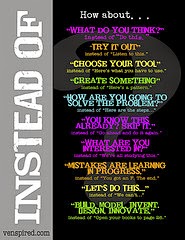
Edutopia re-posted an article today entitled 5 Powerful Questions Teachers Can Ask Students because the talented Krissy Venosdale at http://venspired.com/ designed a cool classroom poster to remind ourselves to open more doors through our questions rather than closing them through statements. (ie dynamic rather than static thinking - see #CyberPD Opening Minds Chapters 1-3 ).
Here is an image of the poster, but if you would like a good version of it, go to Krissy Venosdale's Flickr site. She also is offering a printed versions (for only $4.00) at MagCloud. Seems totally worth it!
Monday, July 21, 2014
#CyberPD Week 3 - Chapter 5 - Know Thyself
Supposedly, Socrates uttered these words, "Know thyself" but the roots of wanting to understand the self probably goes back much further. Why would I bring philosophy into a conversation about literacy? Well, chapter five is about Wild Readers Showing Preferences for reading - genres, authors, series etc. To be able to have a preference, one must know thyself. What do I like/dislike? Why? How might this help me select books I enjoy in the future? How do I need to challenge myself as a reader?
At the beginning of the chapter, Donalyn reflects on her own preferences, therefore I reflected on mine. Not only do I have clear preferences, but these preferences are dependent on the role I'm playing and the context I'm in. I listen to non-fiction business and self-help books before bed to wind-down, but I don't read them. I enjoy a good science fiction book as an escapist read when I need to turn off my own thoughts for awhile. On an airplane, I prefer a realistic fiction book because it is easier to pick up and put down during interruptions and still follow the story. For some light or vacation reading, I'm currently collecting food-themed fiction and mystery books. Every few years I will re-read Anne McCaffrey, L.M. Montgomery, Louisa May Alcott and Sue Bender. In my professional life, I'm reading about language use, writing, and literacy as a cultural practice. Resnick (1990) categorizes literacy practices into various purposes: the sacred, the informational, the pleasurable, the persuasive and the personal-familial. Since we all read/write for different purposes, it would seem reasonable that we would have different preferences in different contexts. I wonder if my students could create a list like this - not just what titles/authors they prefer, but when and where they prefer to read particular titles/authors/types/genres?
But, I will admit that I haven't "pushed [myself] to read widely in order to best serve our students" (p. 167) as Donalyn recommends. There were some young adult titles that I would read summaries and recommendations about, rather than actually read the book. I greatly depended on the Cooperative Children's Book Center to help me recommend titles of areas I was ignorant about. Although many children learn the habits of networking to find books they enjoy, we need to be aware of the children who use vague terms like "scary" or "funny" books to describe their preferences. This is an indication that the child hasn't read widely enough to start defining his/her specific preferences. Might this relate back to not just personal taste, but reading in a variety of contexts?
As I was reading, I created what I imagined will be Hints or Guidelines for Teachers about helping students create preferences in reading:
Why does all this matter? And I'm not just talking about chapter 5, but why think about providing time to read in class and help students develop habits of reading on the edges, guide students to become confident self-selectors of reading materials, share their reading with others, and have reading plans? Because as Donalyn states so eloquently "By the end of the year, our students have practiced all of the lifelong reading habits in our classrooms, they have reflected on their personal reading behaviors, and they have developed the tools and skills they need to become independent readers without our support. . . Their reading lives belong to them and they don't need us. They are wild readers now (pp. 192-193)
Resnick, L. B. (1990). Literacy in school and out. Daedalus, 119(2), p. 169-185.
At the beginning of the chapter, Donalyn reflects on her own preferences, therefore I reflected on mine. Not only do I have clear preferences, but these preferences are dependent on the role I'm playing and the context I'm in. I listen to non-fiction business and self-help books before bed to wind-down, but I don't read them. I enjoy a good science fiction book as an escapist read when I need to turn off my own thoughts for awhile. On an airplane, I prefer a realistic fiction book because it is easier to pick up and put down during interruptions and still follow the story. For some light or vacation reading, I'm currently collecting food-themed fiction and mystery books. Every few years I will re-read Anne McCaffrey, L.M. Montgomery, Louisa May Alcott and Sue Bender. In my professional life, I'm reading about language use, writing, and literacy as a cultural practice. Resnick (1990) categorizes literacy practices into various purposes: the sacred, the informational, the pleasurable, the persuasive and the personal-familial. Since we all read/write for different purposes, it would seem reasonable that we would have different preferences in different contexts. I wonder if my students could create a list like this - not just what titles/authors they prefer, but when and where they prefer to read particular titles/authors/types/genres?
But, I will admit that I haven't "pushed [myself] to read widely in order to best serve our students" (p. 167) as Donalyn recommends. There were some young adult titles that I would read summaries and recommendations about, rather than actually read the book. I greatly depended on the Cooperative Children's Book Center to help me recommend titles of areas I was ignorant about. Although many children learn the habits of networking to find books they enjoy, we need to be aware of the children who use vague terms like "scary" or "funny" books to describe their preferences. This is an indication that the child hasn't read widely enough to start defining his/her specific preferences. Might this relate back to not just personal taste, but reading in a variety of contexts?
As I was reading, I created what I imagined will be Hints or Guidelines for Teachers about helping students create preferences in reading:
- As teachers, we need to help students develop a more sophisticated understandings of genres to include the sub-genres. As Donalyn highlighted, not all sci-fi books have robots in them. In fact, one of my favorite sci-fi books is a re-telling of Jane Eyre (Jenna Starborn by Sharon Shinn). Not all mysteries have a murder. Not all romances are happy.
- As teachers, we need to accommodate students' preferences while expanding their reading repertoires and challenging them to explore new styles. This is a fine line to continue to encourage the text that students like AND introduce the unfamiliar.
- As readers, we need to expand our own understanding and acceptance for non-traditional genres. Styles, genres, and modes of text are changing constantly. Remember, at one time it was thought that BOOKS would be the downfall of civilization.
- As teachers, we need to expose students to more non-fiction in a variety of contexts. For many students, non-fiction has been assigned reading or report reading and they have lost the joy of reading to learn information. We need to make reading non-fiction as commonplace as reading fiction.
- As teachers, we need to create and use assessments/reflections that fit our goals for students and our own habits of organization. Over the years I've learned to work with my organizational style rather than against it which ensures that I actually keep records and can see the patterns of engagement of my students.
Why does all this matter? And I'm not just talking about chapter 5, but why think about providing time to read in class and help students develop habits of reading on the edges, guide students to become confident self-selectors of reading materials, share their reading with others, and have reading plans? Because as Donalyn states so eloquently "By the end of the year, our students have practiced all of the lifelong reading habits in our classrooms, they have reflected on their personal reading behaviors, and they have developed the tools and skills they need to become independent readers without our support. . . Their reading lives belong to them and they don't need us. They are wild readers now (pp. 192-193)
Resnick, L. B. (1990). Literacy in school and out. Daedalus, 119(2), p. 169-185.
Wednesday, July 16, 2014
#CyberPD - Reading in the Wild - Chapter 3 - Reading is a Social Activity - Chapter 4 - The Badge of a Wild Reader
As
firmly as I now believe that reading is a social activity, as a young
reader I firmly believed in NOT sharing my reading with others. In
school, no one “got” why I read what I read, I was frequently
teased for always having my nose in a book, and no one really wanted
to hear what I thought about what I read. Book reports were
delivered to the sounds of crickets (think cartoon silence) and
construction paper leaves for a tree or cars for a train lining the
classroom walls were written up to prove my progress to a class goal
of reading so many books. In high school, when we were finally
allowed to “discuss” books, the conversation was very teacher
driven and focused on proving we read the book and understood the
symbolism. I did not experience a community of readers, who eagerly
read, shared and supported each other, until I became a middle school
teacher. Not only did I try to foster this type of environment in my
classroom (surviving without a classroom library because my school
didn't believe in such things) but as I attended my first
professional conferences, I connected with other middle school
teachers who enthusiastically shared their reading, made significant
recommendations for books for my students (and me), and embodied
lives of wild readers. In the challenging days of a first year
teacher, these wild readers (like Linda Rief who actually wrote me
encouraging letters and sent her own students' work) inspired me to
“keep calm and read a book” and I continue to advocate for
reading time in school, student choice, and, as chapter three
details, help my students (both young and adults) to “share books
and reading with other readers” (p. 87).
Donalyn
quotes Jeff Wilhelm (who is another of my teacher idols) from a
conference when he stated, “What's your bottom line? What do you
really want to happen for your students? Now, how does what you do
every day serve that bottom line?” (p. 89). I've been pondering
this lately and I'm reminded of an activity my teacher-husband did
with a group of high school students. They were reading The 7
Habits of Highly Effective Teensby Sean Covey
and for Habit 2: Begin with the End in Mind, my husband asked the
students to create and design bumper stickers for their own life motto
or mission statement. More recently, Daniel Pink asked the question,“What's your sentence?”
So, what is your literacy teaching mission/motto/sentence?
I'm
playing with this one:
Donalyn
describes many of the negative factors I experienced as a young
reader – the demeaning social stereotypes of readers, the limited
access to books at school and a school community that didn't support
wild reading and social engagement with reading. Yet, even more
importantly, Donalyn provides numerous suggestions on how to “foster
school and home reading communities” (p. 91) and delineates the
“benefits of reading communities” (p. 96). The main idea here
is creating a sense of community – developing relationships and habits of
mind both in school and at home that center around reading and
writing. As I mentioned before, I had supportive reading parents and
I learned to cherish the smell of bookshops and libraries and
interact with readers outside of school. I wonder how much more would
I have engaged in school and enjoyed it, if I didn't have to hide the
reader side of my life? I wonder how many other children still feel
this way?
Besides
many suggestions on how a teacher, classroom and school can create
and sustain community connections, Donalyn shows how to help a new
teacher embrace a wild reading life. I wept in awe reading Malorie's
(a student teacher) initiation into the classroom community of
readers. As Donlyn describes, “Watching Malorie talk with two of
our students about the book later [The Hunger Games], I realized that
Malorie had crossed over. She wasn't a classroom observer anymore.
She was part of our reading community with powerful reading
experiences and opinions to contribute. Our students respected
Malorie's teaching role in our class, but they embraced her because
she read alongside us” (p. 106). When I work with teachers, I know
the importance of providing not just lip-service to these principles,
but a functioning and successful model of a reading/writing workshop.
For many teachers, it is the first time they have gotten to
choose to read titles of their own selection and discuss something
other than guided reading questions. The process of experiencing and
envisioning a wild reading and writing classroom is essential in
creating wild reading and writing teachers.
I
love Banned Book Week because, as Donalyn states “books could be subversive contraband,
worth passing back and forth among friends. Books hold secrets that
you can share with other[s]” (pp. 108-109). I remember sneaking
books from under my mother's bed – they were adult mysteries or
horror novels and non-fiction crime stories, yet I felt I was
rebelling against the cheesy teen romances that were the rage in my
classroom. When Donalyn noticed a secret book her boys were reading,
she read it too, but found it held little opportunity to grow as a
community. Instead, as she stated, “My role changed from reading
advisor to reading policeman” (p. 109). So now, when the secretive
book is passed along, she takes note, but doesn't interfere. I
wonder, how do other teachers handle banned or controversial books in
their classrooms?
I
know conferring with readers is a constant struggle for many teachers
new to the workshop approach. They ask the same question Donalyn
did, “What's the point?” And, most teachers I've met tried
checklists, notebooks or post-it notes to keep track of who they
conferred with and who they haven't. Donalyn challenges us to think
about why we want to confer with readers. In her classroom, it was
to “forge relationships with each one [student]” (p. 131). To
ensure this happened, Donalyn reflected on her own personal style of
conferring and worked with this style, not against it, to create a
process that provided consistency, growth, assessment, and evidence.
After explaining her process, she also highlights her colleagues
variations. The important part is that “conferring with my students
is finally meaningful and manageable” (p. 134). I want to copy the
last few pages of chapter three and send them to all the workshop
teacher I know! It is such a comfort to realize that even master
teachers struggle with this practice.
Here's my badge of a wild reader. What does your badge look like?
Chapter 4 - Wild Readers Have Reading Plans
Here's my badge of a wild reader. What does your badge look like?
Clearly, Donalyn is a wild reader. I've followed her on Twitter for a while (@donalynbooks) and love her recommendations. But, beyond having stacks of books and lists of books, wild readers need to have a plan for when and how they are going to read their stacks and lists of books. Goal setting - for time read, amount of pages read, types of books read, or amount of books read - gives wild readers a destination and a challenge to become more widely read wild readers.
In the past few years, I've started my own book blog to become accountable to a public audience and reconnect to my readerly life. On the blog, I tried a few book challenges, such as the Outdo Yourself Reading Challenge sponsored by the Book Vixen; Off the Shelf Book Challenge by Bookish Ardour; or The Big Book Challenge by Book by Book. What challenge might you take up in the next few months?
Wednesday, July 09, 2014
#CyberPD - Reading in the Wild - Chapter 1-2 - Alleluia!
As
much as I love #CyberPD, I kind of think that by selecting this book,
the choir is being preached to. Based on my experience in past years
with #CyberPD, I think that most of the teachers and educators
joining us will be singing, “Alleluia” as they read Donalyn
Miller's Reading in the Wild as
it confirms, validates, and supports many of the practices that we
know are good for kids. And not in the “raise test scores” kind
of good, but good in the way that helps students become life-long
readers. As Donalyn states early in the Introduction, this is not a
program to be implemented, but a way of thinking about how life-long
readers and writers integrate reading and writing into their lives
and then applying those principles to the classroom to help students
develop the habits of life-long readers.
With
all the current tension surrounding the implementation of Common
Core, and in many states, the newly minted Smarter Balanced
Assessment System, I found it interesting that Donalyn returned to
the 1996 NAEP report for this quote, “Students must no only develop
the ability to comprehend what they read, but also develop an
orientation to literacy that leads to life-long reading and
learning.” I don't know about your own school districts, but
around me it seems like we are moving further away from this ideal –
to not only create students who can demonstrate the skills of
reading, but inspire students to actually want to read and write
outside of school and develop positive dispositions towards engaging
in literacy for their own purposes. Or, as Donalyn writes, to foster "their capacity to lead literate lives.” (p. xx) Wouldn't that be an
amazing part of any school's mission statement?
Donalyn
reminds us, “living a reading life requires some commitment” (p.
2) and highlights that too often, students have to wait until
adulthood to create a readerly life because many literacy classrooms
focus on skills and strategies, rather than the full experience of
becoming a reader. I enjoyed reviewing the Classroom
Non-Negotiables: 1) Provide time to read and write 2) Give choice to
students 3) Provide multiple opportunities to respond to reading 4)
Create a community around literacy and 5) Create structures to
support students and teachers to learn more and assess their work
together. Although these non-negotiables are very familiar (I was an
early adopter of Atwell's workshop approach), it is good to be
reminded of the essence of classrooms that foster the habits of
life-long readers. These habits are so essential because those who
become life-long readers are “readers who incorporate reading into
their personal identities to the degree that it weaves into their
lives along with everything else that interests them” (p. 3).
Managing
time is one of the biggest factors in determining if one will become
a life-long reader. With so many requirements, responsibilities and
distractions, it is easy for reading to be pushed aside for other
things. Chapter 1 focuses on how we can “practice living like
readers” (p. 9) by snatching reading time on the edges (the
multiple few minutes of time spent waiting that inevitable happens)
and getting into the habit of always having book available for
“reading emergencies” (p. 14). Lately I have gotten into the habit
of downloading books to my smartphone. I have been amazed at how
much more reading I've been doing just because I always have a book
with me. Like many of Donalyn's students (and my own), I have been
under the false assumption that I need to have long stretches of time
to really be reading, but the 3 minutes here and 10 minutes there
allows me to savor a book as I have time to mull over sections,
rather than racing through the book. However, I do have to admit that
I am a horrible binge reader and will, at times, stay up for hours
reading. And again, now with having books on my smartphone, I don't
have to turn on the lights and bother other people, so I sneak in a
lot more midnight reading.
Self-selecting
books is essential to developing life-long reading habits, and
Chapter 2 reviews how readers learn to select books through multiple
networks, community conversations, and read alouds. I was fortune to
grow up in a household that a trip to a used bookstore was common and
it was expected that each of us would leave the store with multiple
books. My parents never censored my reading, though they were well
aware of my choices and available to discuss things with me. Most of
the books that I have learned to hate are those that I was assigned
to read and dissect. I hated it when teachers told me, “Don't read
ahead!” If it really was a good book, I couldn't help myself!
I
have really enjoyed how Donalyn has incorporated the research behind
each of her recommendations, provided teaching anecdotes to show life
in a real classroom, and given us access to all her handouts and
forms. She has really opened both her classroom and her thinking to us - showing how she thinks through planning a literacy block, takes notes on students' work, and even how to spot students who are fake reading. Although many of the ideas are not new to me, I'm learning
new ways to demonstrate to other teachers how to make the transition
to independent reading or reading/writing workshop less daunting.
She has even illustrated how to create and maintain a solid classroom
library. I wish I had this book when I started teaching!!!!!!!!
Friday, June 27, 2014
#CyberPD - Reading in the Wild - Book for Summer 2014

#CyberPD is one of the best professional development over summer! I have had the honor of participating in the last few years and this year promises to be even better!We will be reading and discussing Reading in the Wild by Donalyn Miller with Susan Kelley.
If you are interested in participating, go to Literacy Learning Zone to find out how.
#cyberPD 2014: Reading in the Wild by Donalyn Miller (@donalynbooks)
July 9th Chapters 1-2 Hosted by Cathy Mere at Reflect and Refine
July 16th Chapters 3-4 Hosted by Laura Komos at Ruminate and Invigorate
July 23rd Chapter 5 & Appendices Hosted by Michelle Nero at Literacy Learning Zone
July 30th @ 7 PM (CST) Twitter Chat with the author Donalyn Miller
Friday, March 07, 2014
PowerPoint or Pointless
As a classroom teacher, I didn't use PowerPoint a lot, not because I couldn't, but because it was such a static medium. I used the old fashioned overhead that allowed me to write, draw, and design visuals that followed the conversation we were having. However, at times, PowerPoint was very relevant and I especially wanted to teach my students how to leverage PowerPoint to their advantage, and not stumble, like so many do, into creating slides with too much text and spending too much time reading their slides to the audience.
However, as an academic, I'm frequently speaking to large audiences in spaces that typically encourage, if not require, some sort of visual presentation. Several years ago, I participated in a PechaKucha night and it was a revelation of what PPT could inspire. Since then, I've had the pleasure of experiencing a few professional speakers and researchers who use PPT to strategically illustrate points and/or reinforce the mood/tone of their speech, rather than provide the entire text of their speech.
Rebecca Schuman takes on the pointlessness of PPT in higher education with her entertaining and informative presentation PowerPointless: Digital slideshows are the scourge of higher education. It blithely highlights the horrible habits we have all gotten into when using PPT and exposes what our students really feel about our use of text-heavy, dull, and outdated presentations. As she states, mid-way through her presentation, "A presentation, believe it or not, is the opening move of a conversation - not the entire conversation."
Although I continue to create presentations for conferences, I hope that my move toward the use of graphics and strategic selection of quoted data helps build the audience engagement in what I'm presenting. A little later in her presentation, Schuman states, "If your audience can understand everything it needs to from your slides only . . . cut 50% of the slides and 90% of the text." In other-words, if the slideshow can be read like a book, what's the point of me standing in front of you speaking? You could read it on your own time!
What do you think?
Monday, February 17, 2014
Researchers as Writers - for whom and how?
Right now there is a major debate going on through multiple academic
listservs. It revolves around a recent article by Nicholas Kristof in
the New York Times entitled "Professors, We Need You".
He begins the piece with a provocative opening, "Some of the smartest
thinkers on problems at home and around the world are university
professors, but most of them just don’t matter in today’s great
debates." He continues to point out the "the anti-intellectualism in
American life" and how, at times, professors themselves are to blame for
this - as generally, they are not (or are prevented from) engaging in
public debates of importance. As researchers/professors, publication is
a crucial part of tenure, but the audience and purpose is not
necessarily to impact local, state or national policies or programs.
Instead, too often, academic research is written for academic
researchers. And, to be part of that great conclave, one must learn and
use the academic jargon (or Academic Jibberish as Stephen Krashen calls it), required for admission. Instead of writing for the masses, professors are writing for the select few.
In
my own dissertation, I selected to use the "three article option"
rather than the traditional five chapter format. In addition, I
deliberately selected practitioner-read journals as my target journals,
rather than academic elite journals. My research focused on researching
with and learning from teachers, and it was my goal that other teachers
would be interested in and enjoy learning from them too. To bridge the
worlds of the researcher and the practitioner, I took Duke and Beck's
advise to write the dissertation as a series of articles in a “genre
authentic to the field” (1999, p. 34).
However, Kristof is not only critiquing academic report writing, but he continues that "Professors today have a growing number of tools available to educate the public, from online courses to blogs to social media. Yet academics have been slow to cast pearls through Twitter and Facebook." This is not surprising to me, as many academics don't receive "credit" for non-official writing such as social media or local opinion pieces. If the process of tenure rewarded public engagement, then I'm sure more professors would involve themselves in this. An organization that has been trying to influence this policy is Imagining America Organization and it recognizes that public scholarship needs to be supported.
Allen Berger, in his article "Writing about Reading for the Public" (The Reading Teacher, Sep. 1997), suggests that as literacy professionals, we need to learn how to write for publications that the public reads - which means understanding the style, format, length and audience for various publications. In addition, according to Berger, we need to be reading the publications that influence public opinion and, rather than just responding to criticism, we need to be opening the doors to dialogue on issues and topics that we want to debate publicly.
As an early career scholar, I've grown up academically with digital spaces supplementing my traditional training. I read blogs from graduate students, international teachers, writers and professors to gain insight on the intellectual work they are doing and sharing through their "slice of life" blog entries. I actively participate in Twitter chats as a teacher, teacher-educator, adjunct faculty, and writer. These conversations, with other engaged and excited people continue to inspire me to question further, read more, and consider other viewpoints. One of the best things that I've learned on the web is to follow people with opinions very different from my own and not only "like" those who share my opinions.
![]() |
| HistoryImages.com: free clip art |
However, Kristof is not only critiquing academic report writing, but he continues that "Professors today have a growing number of tools available to educate the public, from online courses to blogs to social media. Yet academics have been slow to cast pearls through Twitter and Facebook." This is not surprising to me, as many academics don't receive "credit" for non-official writing such as social media or local opinion pieces. If the process of tenure rewarded public engagement, then I'm sure more professors would involve themselves in this. An organization that has been trying to influence this policy is Imagining America Organization and it recognizes that public scholarship needs to be supported.
Allen Berger, in his article "Writing about Reading for the Public" (The Reading Teacher, Sep. 1997), suggests that as literacy professionals, we need to learn how to write for publications that the public reads - which means understanding the style, format, length and audience for various publications. In addition, according to Berger, we need to be reading the publications that influence public opinion and, rather than just responding to criticism, we need to be opening the doors to dialogue on issues and topics that we want to debate publicly.
As an early career scholar, I've grown up academically with digital spaces supplementing my traditional training. I read blogs from graduate students, international teachers, writers and professors to gain insight on the intellectual work they are doing and sharing through their "slice of life" blog entries. I actively participate in Twitter chats as a teacher, teacher-educator, adjunct faculty, and writer. These conversations, with other engaged and excited people continue to inspire me to question further, read more, and consider other viewpoints. One of the best things that I've learned on the web is to follow people with opinions very different from my own and not only "like" those who share my opinions.
Thursday, February 06, 2014
Getting to Know the Characteristics of Good Teachers
For most pre-service teachers, they have had 13+ years of "apprenticeship of observation" (Lortie, 1975) - that is, they have been students in schools for thousands of hours and seem to know what teachers do everyday. However, as any classroom teacher will tell you - there is a lot of time, thought and effort that goes on behind the scenes that students never see. As a teacher-educator, I hope to help my pre-service teachers become more aware of how their previous experiences as students influences their understanding of teaching and learning and their own development as teachers.One of the first activities I ask my pre-service teachers to complete is a quick review of the "characteristics of effective teachers". To accomplish this, I ask the students to search for and view four YouTube videos using search terms like - characteristics/qualities/traits and good/effective/excellent and teachers. The students take notes on the author and purpose of the video and what characteristics were discussed. Then, in small groups, the students combine their observations for a group list - which is then compared against the other groups. It is not surprising, but the results are fairly consistent - passionate, enthusiastic, knowledgeable, fair, organized, supportive, patient, caring, friendly, respectful and creative.
I then introduce the book "Thank You, Mr. Falker" by Patricia Polacco, which is a memoir of her struggles with dyslexia in school and the teacher who made a difference for her. Jane Kaczmarek reads the story in this Screen Actors Guild video. Using a Quick Write, students reflect on the teachers who have influenced them the most and share their responses with a partner.
Finally, in small groups, students draft a job description for a teacher. This would include the objective, summary statement, qualifications, duties/responsibilities, required skills, and desired skills. It could also include the salary range and hours.
For many students, this was the first time they have broken down the actual job of a teacher into the smaller parts to consider the daily tasks of not just lesson planning and teaching, but communicating with staff and parents, assessment paperwork, additional duties like lunch and recess, after school activities, and assorted professional meetings. I chuckled when one student commented, "Hmmm... I guess I should really look into actual job descriptions, considering this is what I want to do."
Thursday, December 05, 2013
Put One Word After Another Until Done
Publish or perish is the axiom for many scholars and academics, and it is true in many cases. However, that proverb frames the practice of writing as an unwelcome dictum. For the past few days, I've been gleaning words of inspiration, portraits of struggle, and motivation to continue to make meaning of my life, teaching and research through writing at the Living the Writerly Life session and study group at the Literacy Research Association conference 2013. Although the genre of academic writing is a bit particular – there are a lot of useful tidbits for writers of all sorts.
One of the most bountiful sessions for inspiration and advise was sponsored by the Living the Writerly Life study group organizers and was entitled “ We All Have Something to Say: Strategies for Living the Writerly Life.” In this alternative format sessions, well-published scholars speed-dated us in small groups and shared their collective wisdom of writing.
Julie Coiro, from the University of Rhode Island, encouraged many practices that writing teachers in schools encourage – read a lot with an eye to craft; keep a writer's notebook of ideas; write the first draft as a freewrite and craft it for specific purposes later; and find critical friends (especially classroom teachers) to get feedback. It is important to clarify personal interests to focus a research agenda that is manageable. As many others reiterated later – aim for a revise and resubmit (R&R), as that means a journal is interested and willing to work with you to craft the final piece. Celebrate this!
Beth Dobler, from Emporia State University, advised to find the kernel of a topic that you really care about because you will be with it for a while. In addition, 85% of writing time is really pre-writing – the thinking, planning, and researching of a topic. Provide the time to do this well and the final piece will be stronger.
Lori Assaf, from Texas State University, counseled us to not just celebrate R&R, but to get them revised and resubmitted as soon as possible. When they languish on the “to do” pile, they tend not to get done and as time passes, the piece becomes out of date. As educational researchers, we need to be aware of the various audiences we need to interact with, therefore try to craft three different pieces on a topic or data set – one for a research journal, one for a practitioner journal, and one as an opinion piece.
Laura Pardo, from Hope College, urged us to keep a writer's notebook. A consistent place for writing encourages writing as a habit and practice, and should include more than just academic writing. She has sections and tabs in her notebook for different ideas and purposes.
Doug Kauffman, from the University of Connecticut, commented that “writing is a blue collar job rather than artistry”. He encouraged us to get rid of the idea that writings needs to be pretty and artful. Just get stuff on the page. With something on the screen, there is something to revise. If we think of revision as an act of play and experimentation, then we don't have to wait for inspiration to hit. The artistry of writing comes through revision, not generation.
Beth Maloch, from the University of Texas at Austin, talked about balancing teaching and research. Her best advise was to hold fast to the suggested allocation of time that many research institutions use – the 40/40/20 of teaching, research and service. In a 40 hours work week, this means that 16 hours should be devoted to research/writing. Just like classes and meetings, this should be on your schedule!
Taffy Raphael, from the University of Illinois at Chicago, posed a powerful question, “What do you need to move forward in your writing?” Identify that need and work to make it happen. For her, Taffy mentioned the need for collaboration, writing retreats, and discipline (with time and distractions). Use what you currently do (classes, presentations) to get started on writing. Tape your conference talks (the best version) to transcribe to a paper.
Besides this alternative session – the daily study group is truly a motivating factor for many people who return each year. The study session helps us clarify our goals – both immediate and long-term, and provides peer accountability and deadlines for these goals
Tuesday, December 03, 2013
Twas the Night Before LRA
Twas the night before LRA, and all through Love Field,
The teachers and researchers were departing their flights.
The program was set, with thoughtful reviews
In hopes that all attending scholars would happily choose.
The students back home were all snug with a substitute,
Or eagerly anticipating a day of peaceful solitude.
As academics with PPTs prepared to show off their learning,
We settled our brains for four days of discerning!
In the lobby of the Omni Hotel there arose such a clatter,
“I haven't seen you since last year – let's have a a quick chatter!”
Good friends and the colleagues we meet only here,
Enjoy the warmer climate of Dallas this year.
Dallas, a site of both cultural icons and historical meaning,
Provides a good space for our personal gleaning,
Transformative Literacy: Theory, Research, and Reform,
Our mission – that powerful, critical literacy becomes the norm.
With R. Beach and T. Rodgers we will soon understand
Digital Texts Through Social Practices, will be absolutely grand.
They soon will be joined by K. Chandler-Olcott, and A. F. Ball,
F. Boyd and T. McCarty – in Plenaries for all.
Besides large group sessions, there's papers for all:
Besides broad categories of quant and qual
We'll dive into case study, mixed methods, and more.
The possibilities are endless, it's so hard store!
As people engage in dynamic sessions,
The Twitter feed #LRA13 will ask many questions.
But don't forget to feed both your stomach and mind,
To be social and meet everyone, especially newbies, is kind.
An then in a twinkling, the conference will come to an end.
With new contacts and friendships, and papers to pen.
We will return to our schools and our colleges fresh,
Recognizing that our LRA community is truly blessed.
Dedicated people and volunteers galore
Provide yearly meetings that refresh us to the core.
Thank you all officers, elected and served,
Our gratitude is endless, and all is deserved.
Let's meet again next year, some place in the East,
While our daily work with powerful literacy will never cease.
And never forget Frederick Douglass's plea
“Once you learn to read, you will be forever free.”
Tuesday, November 12, 2013
Misunderstood Minds – An Introduction to Children Who Learn Differently
I recently
discovered a wonderful resource to help teachers and parents better
understand learning issues. Learning differences and difficulties
are notoriously tough to understand and recognize. In the past,
students who learned differently were often segregated to separate
schools or classrooms and were denied a quality education. In the
1970s, with the Individuals with Disabilities Education Act (IDEA),
more attention was given to supporting students who learn differently
in the regular classroom – however, it was still often seen as the
Special Education department's job to identify and support students.
Unfortunately, too often students needed to have significant
achievement gaps, behavioral issues, or failures before support was
provided.
More recently, with the implementation of Response to
Intervention (RTI), classroom teachers have the responsibility to
identify students who need more individualized support in a proactive
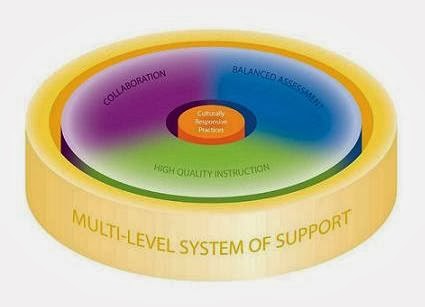
manner. The model in Wisconsin centers on culturally
responsive practices, using collaboration, balanced assessment, and
high quality instruction within a multilevel system of support to
help students achieve academic standards.
This has the potential to significantly decrease the
referrals to special education for all students. It also challenges
the traditional model of education that assumes all students learn
the same and if not, the problem is with the student. Instead, RTI
recognizes that students learn differently and some may need more
individualized instruction based on their strengths (not just
deficits) to achieve.
An
excellent resource to introduce teachers to the complexities of
learning differences and difficulties is the PBS video "Misunderstood Minds." It follows three years in the lives of five families
whose children struggle to learn. In addition, there is an excellent
companion website that provides definitions, explanations, and
resources for learning difficulties in reading, writing, math and
attention. One of the most unique aspects of the website are the
“Experience Firsthand” activities that simulate what it would
look and feel like to have a particular learning difficulty. The
video is about 90 minutes long but provides an excellent personal
portrait of each of the children, the struggles of their families,
and the complexities of understanding learning difficulties. I will
provide a brief summary of the video.
The
first student introduced was Nathan VanHoy, who struggled to read.
His struggles were masked by his strong verbal skills and ability to
memorize, but he knew he wasn't reading like his classmates. After
intensive testing, he was diagnosed with a phonemic awareness problem
-- an inability to innately distinguish between the different letter
sounds that form words. With great trepidation, his mother made the
decision to have Nathan have lessons in the school's resource room
which provided intensive training in phonemic awareness. He made
progress, but also had plateaus.
The next student profiled was Lauren
Smith, who was creative, dramatic and social, but had difficulties
with focus, attention, and organization. In addition to academic
problems, Lauren had difficulty making and keeping friends. These
issues helped her doctors diagnose an attention difficulty, that most
likely resulted from an imbalance of dopamine in her brain. Hesitant
to use medication for Lauren, her parents decided to try sending
Lauren to a different school, which at first seemed to help. But,
when the newness wore off, Lauren continued to have academic and
social difficulties. Her parents agreed to try medication for Lauren
in addition to other strategies, such as coaching in academic and
social interactions, organization tools, and time management. With a
multi-tiered approach, Lauren found more success.
Next the video
introduced Sarah Lee. She was very popular, highly social and
interactive until about fourth grade. At that time, she began to
struggle to articulate her ideas in class and stopped participating.
After some testing, the speech and language specialist recognized
that Sarah Lee had expressive language deficiency and recommended a
full and ongoing language immersion program - almost like second
language instruction. With constant practice and feedback, Sarah Lee
made significant improvement.
The next segment profiled Adam,
who struggled with reading throughout elementary school, but when
tested was determined to be "average" so his learning
difficulties were not identified until high school. At that
point, he hated school and skipped it, turning to the streets to find
acceptance. Unfortunately, this led to using alcohol and drugs
to numb his frustration and disappointment and stealing. When
caught, he was jailed, but being sober and attending classes, he
began to make progress. Unfortunately, when he returned to high
school, he did not receive support and was eventually expelled.
Without a diploma, his options are limited.
The last story
focused on another Nathan, who showed frustration and aggression in
kindergarten. An early diagnosis indicated ADD, but medication
didn't seem to work. He stopped taking it and his mother decided to
home school. He continued to struggle and began to exhibit
depression and suicidal thoughts. At this point, he met with
Dr. Levine, who found Nathan was highly intelligent and had strong
visual skills, but struggled with graphomotor (writing) skills - in
other words, he knew what he wanted to write, but struggled to form
the words. Dr. Levine showed him how to use his strengths to
support his writing. In addition, Nathan's parents decided that
more structure and discipline would help Nathan and they enrolled him
at a military school. At the end of the first year, Nathan had
regained some confidence and found more success in his academics.
This video
illustrated the long and difficult process that many families go
through to support their children who learn differently than others
in school. The children who struggle to learn also struggle with
negative emotions such as teasing from classmates, disappointment of
the adults around them, and the constant labels of lazy, stupid or
obstinate. Learning difficulties are not easy to assess and diagnose,
and children often learn survival strategies that mask the real
problem. Once a learning difficulty is diagnosed, there are many
difficult decisions that need to be made. The video also showed the
struggle of the parents - to readjust their understanding of their
children, to make life-changing decisions, and to work within and
outside of schools' special education perimeters. It also
illustrates the importance of social, cultural and economic capital -
as the parents needed to negotiate multiple systems of support and
expectations.
Winston Churchill,
former British Prime Minister, had learning difficulties in school.
He was quoted with saying, "I was, on the whole, considerably
discouraged by my school days. It was not pleasant to feel oneself so
completely outclassed and left behind at the beginning of the race."
It is essential that,
as teachers, we identify student early who
struggle and provide support, rather than make assumptions about home
life, work ethic and attitude. As one of my pre-service teachers
reminded us in discussion, “You know what happens when you assume?”
. . . . I'll let you finish the phrase.
Wednesday, November 06, 2013
Getting to Know You: Using Children's Literature to Introduce Working with Culturally and Linguistically Diverse Students
“There are some themes, some
subjects, too large for adult fiction; they can only be dealt with
adequately in a children's book.” ― Philip Pullman
I was pondering how to introduce
strategies and techniques for working with culturally and
linguistically diverse students to my pre-service teachers. But
beyond looking at English language learners as a group I wanted my
students to personally identify with children who may be very
different from themselves. I wanted them to be thinking about
questions such as: What does it feel like to be an English Language
Learner in a classroom? What are some of the hopes and fears of
students who struggle to speak English in our classrooms? How do
English language learners navigate in a society that is mostly
monolingual?
Children's literature has the unique
characteristic of making a complex topics very personal and visual. I
selected several illustrated children's books and asked groups of
pre-service teachers to read the book together and summarize the
storyline, list what they learned about English language learners,
bilingual and/or immigrant students from the story, and how could
they use the book in their own classrooms. This provided the students
a repertoire of books to use with their students but also new
perspectives of what it's like to be English language learner in
American schools.
Class Mom – Written by
Margaret Mc Namara; Illustrated by Mike Gordon
Summary:
Nia's class is having a party and Nia volunteers her mom to be in
charge, even though she believes her Mama will not want to be in
charge because she doesn't speak much English. Throughout the
weekend Nia did not tell her mom about party. After much agony, and
pretending that she was sick the morning of the party, Nia finally
tells her mom about the party. However Mama pulls through and throws
a great party.
What the
Students Learned: We learned that parents of English language
learners may have a hard time volunteering in the classroom if they
speak another language. What we, as teachers, may perceive as a lack
of involvement does not mean disinterest. We also learned that it is
important for students to connect their languages and cultures to the
work in the classroom.
Using the Book:
We could use this book to show students how everyone's family is
different and how parents may speak many languages.
In English, Of Course –
Written by Josephine Nobisso; Illustrated by Dasha Ziborova
Summary: Josephine
just moved to the Bronx from Italy. Her teacher asked all the
students to introduce themselves. The students were from all over the
world and each began to introduce themselves, but Josephine was
confused by what they said and how they said it. When Josephine tried
to explain where she was from Naples Italy, the students and teacher
did not understand her. Through patience, gestures and pictures the
teacher helped Josephine tell her story and learn new words in
English.
What the Students Learned:
We learned that the misconception of language can scare some
students. English language learners may have a hard time coming up
with sentences and the correct words to use, but they have a lot of
ideas in their head. As teachers we need to provide patients and
resources to students to help them build their language skills and
confidence
Using the Book: By
using this book with our students in the classroom, they may also
recognize that students who may not speak English very well may still
have a lot to say and teach us.
The Rainbow Tulip - Written
by Pat Mora; Illustrated by Elizabeth Sayles
Summary: This
book is about a young girl named Stella. She and her family are from
Mexico. Her mother and father do not speak any English. Stella and
her younger brothers are bilingual. Stella feels like she and her
family are different at the Mayday Parade. Her costume is
multicolored, and everyone else's costume is a single color. Her
parents about hard time interacting with the other parent, making it
hard for Stella to feel accepted. Stella performs well during the
Mayday dance, but is frustrated that her parents cannot talk to the
teacher. At home Stella admit that she likes being the only rainbow
tulip but it was hard too. Her mother answers that it is hard to be
different that it is both sweet and sour like sherbet.
What the Students Learned: We
learned that at times English language learners may feel that it is
difficult to become accepted in the classroom. Because they might
feel that they are very different from their classmates, they may
feel frustrated, scared, or shy. As teachers, we need to help create
an environment that accepts that differences and celebrate what makes
us unique.
Using the Book:
We can use this book to help students express some of their feelings
about what it is like to feel different. In addition it may help our
students be more courageous when they need to do difficult things.
My Name is Yoon – Written
my HelenRecorvits; Illustrated by Gabi Swiatkowska
Summary::
The story is about a Korean girl and her transition to American
schools. At first she did not like moving to America and how
everything was different. When she wrote her name in Korean it was
beautiful and meant Shining Wisdom. In English her name was Yoon,
which she found ugly. For many days in school she learned new words
and tried out new identities such as cat, bird and cupcake. When she
began to make friends and feel like her teacher like her she was then
able to write her English name Yoon.
What the Students Learned:
we learned that it can be hard to adapt to new school and language
at first. Taking on an English name may make it easier for them in
school but it might not feel right to the student. English language
learners may need to create new identities for themselves. In
addition English language learners may be confused by teachers
instructions and do things very differently.
Using the Book:
Although the book shows an English language learner struggling, we
can use the book to show that everybody struggles with somethings. In
addition, this book may encourage students to be more sympathetic
when other students struggle in school and show the importance of
friendship.
Yoko Writes Her Name –
Written and Illustrated by Rosemary Wells
Summary: Yoko
is an English language learner she is picked on for not knowing how
to write her name in English because she only knows how to write in
Japanese. She is frustrated by this fact until a classmate helps her
learn the English alphabet. This same friend thinks it is really
neat that Yoko knows a secret language, Japanese. When the other
classmates see Yoko and her friend writing in Japanese the rest want
to learn it also and they decide to make Japanese their second class
language. When two classmates don't learn how to write their names in
Japanese Yoko teaches them how.
What the Students Learned: we
learned that can be difficult to adapt to a new learning environment.
It takes time and patience but everyone can benefit from the
differences.
Using the Book:
We can use the book as a resource that shows how to value the
richness of different cultures in our classroom. We can use it to
show students that it is okay to branch out and get to know something
you are unfamiliar with.
The Other Side: How Kids Live in
a California Latino Neighborhood – Written by Kathleen Krull;
Photographs by David Hautzig
Summary: This
nonfiction book the the story of how two Mexican-American families
left Mexico and moved to California for better opportunities. It
shows, through photographs, what daily life is like for many
immigrant families including some of the struggles they have in
school, trying to preserve their culture and heritage, having
children translate for their parents, and the importance of family,
both in California and back home. It also highlights some of the
unique celebrations and holidays that are celebrated by many Latino
families
What the Students Learned: We
learned that it is important to include and celebrate children's
cultures in the classroom beyond the traditional mainstream culture.
We also learned about how it can sometimes be frustrating and
isolating to be an English language learner and immigrant to the
United States.
Using the Book:
If we have English language learners in our classroom. This book
might help other students feel more connected with their peers. The
reader will also understand why some immigrants wish to come to
America and the importance of preserving home language and culture.
Class Discussion
Many
of the books dealt with issues of identity. English language learners
are past with so much more than just learning English. They also have
to negotiate the borderlands of their home culture and school culture
and define themselves with in this borderland. The choice of
language and language use is an obvious identification mark, yet
students may not completely identify with the culture of the
language.
Many
students also recognized that the parents of English language
learners may often be misrepresented. Just because the parents are
not at parent conferences, volunteering for class parties, or helping
students with homework, it does not mean the parents are uninterested
in their students education. There may be many factors that might
limit parent involvement in school including different cultural
expectations, language barriers, and demands on time through family
and work.
As
teachers, we need to build on the strengths that students bring to
the classroom, culturally and linguistically. To do this we need to
get to know our students and not make assumptions of who they are or
what they can do.
As a
teacher educator, I am thrilled that my pre-service teachers came to
recognize these very important issues when working with culturally
and linguistically diverse students. It may have been more efficient
to provide a lecture with PowerPoint, but I believe through the words
and illustrations in these children's books the lessons the students
learned will be better integrated into their understanding.
Thursday, September 12, 2013
Life Lessons in Children's Literature

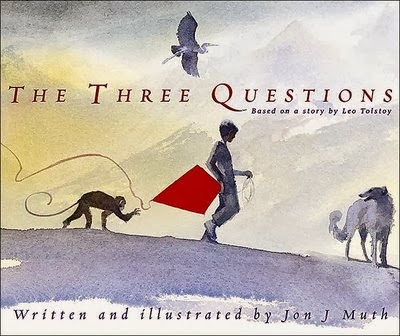
Sometimes a book finds you – rather than you finding a book, and The Three Questions (based on a story by Leo Tolstoy) by Jon J. Muth is a book that found me. In the midst of looking for other topics, my eye was drawn to the muted water color and the fact that there is a children's book based on Tolstoy - not an easy author to understand. I settled down on the floor to enjoy the story.
Nikolai wants to be a good person and
sets out to find the answers to three questions: When is the best time
to do things? Who is the most important one? What is the right thing
to do?
Like most quest stories, Nikolai consulted several creatures:
Sonya, the heron; Gogol, the monkey, and Pushkin, the dog. Each gave
answers according to their own perspectives and experiences and their
answers did not satisfy Nikolai. Figuring Leo, the wise turtle, might
have better answers, Nikolai went to him. Leo was digging and
Nikolai offered to help. In the midst of digging, Nikolia heard a
cry for help and rescued an injured panda and her cub and cared for
them. Through these experiences, Leo observed that Nikolia had the answers to his own questions,
“Remember then that there is only one important time, and that time is
now. The most important one is always the one you are with. And the
most important thing is to do good for the one who is standing at
your side.”
![]() |
| From: https://twitter.com/TeachYOUMatter |
Just recently a teacher mentioned how
discouraged she was with teaching - the Common Core mandates, a
district imposed literacy curriculum, and general disrespect of the
teaching profession. She said, “There are days that I wonder if it
matters. What are we doing?” I reminded her of the tale of
the boy walking down the beach and finding an old man throwing the
stranded starfish back into the water. There were hundreds of the
starfish on the beach and the boy exclaimed, “Why are you doing
this? There is no way you can save them all!” The old man turned
to the boy, while picking up another, and said, “It matters to this
one.”
The teachers I know matter. Each and
every day they focus on doing the best they can for each child in
their classroom – the ones standing by their side – even in the
midst of overwhelming mandates, testing and general discourtesy. It
matters – to each child – each day – every day.
Thursday, August 29, 2013
First Day Fears and Hopes
Another school year has begun, and this
year, I'm teaching undergrad and graduate courses. But, it is still
a new school year, and whether I'm teaching at a new school or just
being introduced to a new group of students, I still have the first
day jitters. And, I believe, if I ever lose this trait, it is time
to hang up my teaching hat. I think the jitters are important to
remind myself to constantly be learning about myself, my students,
and my content and pedagogy.
Like the actor's nightmare (showing up
on stage and not knowing what play is being performed) I think there are teachers' nightmares. On my first day with my new practicum
students, I shared my first day jitters and my yearly nightmare of
not knowing what classes I'm teaching or having students standing on
desks and throwing paper airplanes at me. I hear some teachers have
the nightmare of showing up naked to class, though I've never had
that one. As my practicum students move into their first classroom
experiences, I wanted them to know that anxiety of new experiences is
okay, but it shouldn't be paralyzing. I found a great illustrated
children's book that really exemplifies this point.
Mr. Ouchy's First Day by Barbara
G. Hennessy is about a new fourth-grade teacher on his first day.
Like many children, he prepares for the first day by buying new
shoes, getting a haircut, has trouble sleeping thinking about the
first day, and gets up early to make sure he is on time. At first,
the children tease him about his unusual name, but as he begins to
engage them in figuring out time, the children begin to discuss how a
minute can be interpreted differently under various circumstances.
And suddenly, it is recess time! The book then jumps to the end of
the day and Mr. Ouchy and the children set goals for learning for the
year. The children want to learn how to whistle, swing on a trapeze,
train a cat, or make doughnuts. When Mr. Ouchy returns home, he is
tired but anticipating the great learning for the year and begins to
read up on the children's interests and dreams of his students
accomplishing their goals.
After sharing the book, I asked my
practicum students to write down a fear, a hope, a question, and
something they hope to learn through the year on post it notes. On
the white board, I drew a chart with each sectioned labels. As the
students thought of something, they could post it, and other students
could read various responses. The ideas ranged from very practical
(What school will I be at?) to very broad (How do I engage children
of all abilities and ages?). Many were concerned about managing a
classroom and they wanted to be the best teacher possible. Others
wrote about their fear of failure and wanting to be an inspiring
teacher.
Although the hopes and fears don't
change much from year to year – whether you are a student or a
teacher, I think it is important to acknowledge that the first day of
school is a day of both excitement and anxiety. Really, this is true
for the first day of any new experience. During the roller-coaster
of emotions, it is good to know that you are not alone and that these
feelings are completely normal. I saw a poster once that said, “The
only difference between fear and excitement is your attitude about
it. - Unknown.” In the fear and excitement of the first day, I
hope to encourage my students to focus on the excitement and let the
engagement in lessons alleviate the fear.
Subscribe to:
Posts (Atom)